
| [ Main index » WHS reviews: Bicycle components tests » Mini pumps | ] |
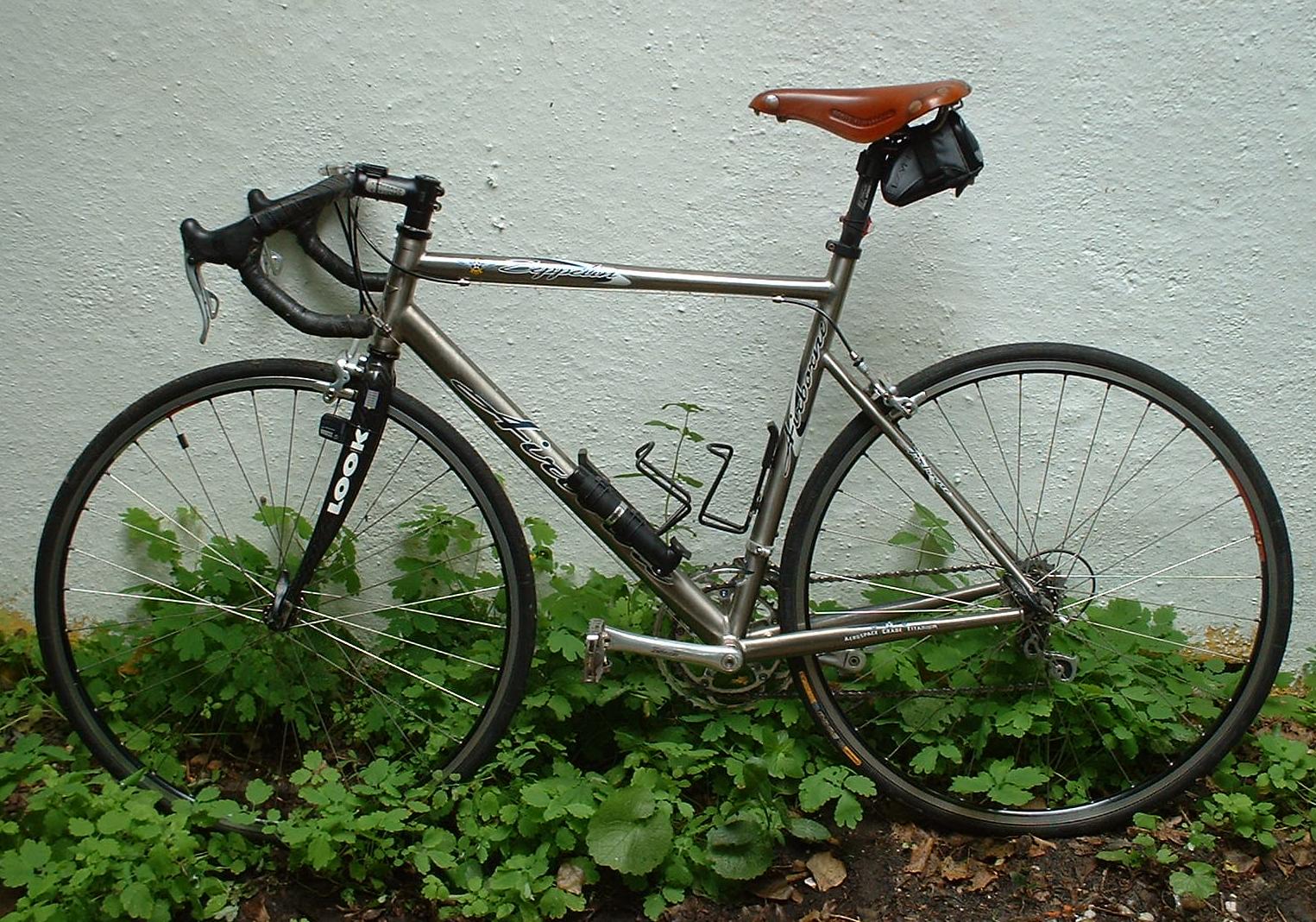
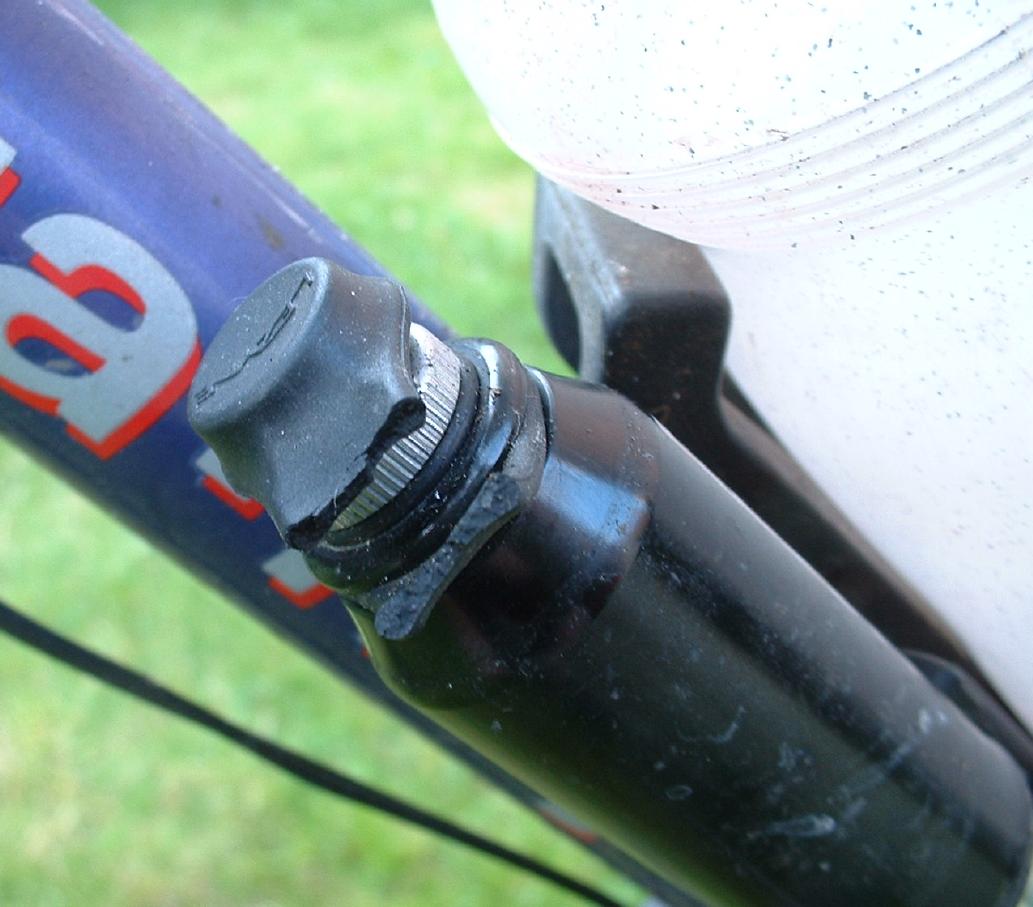
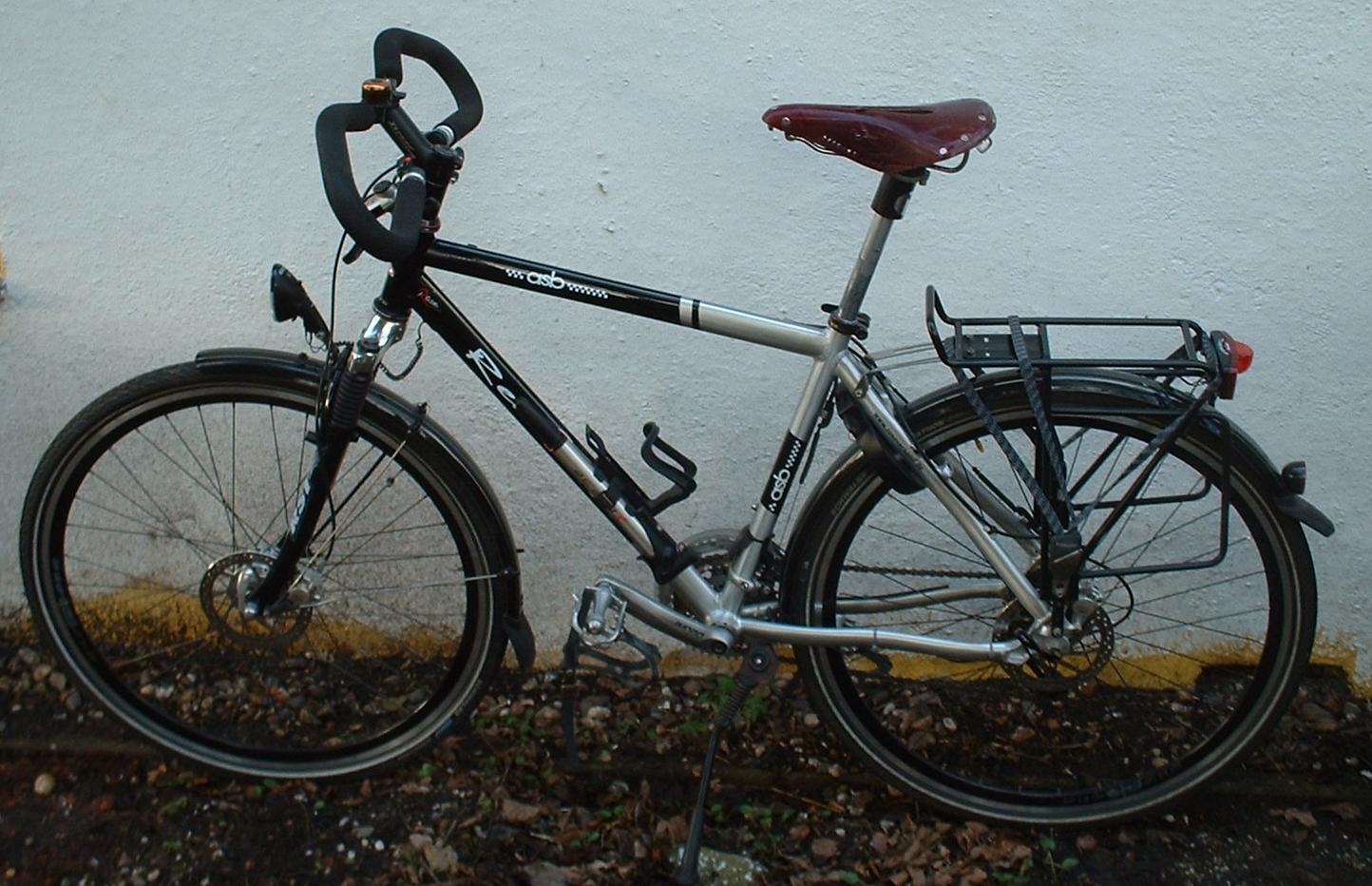
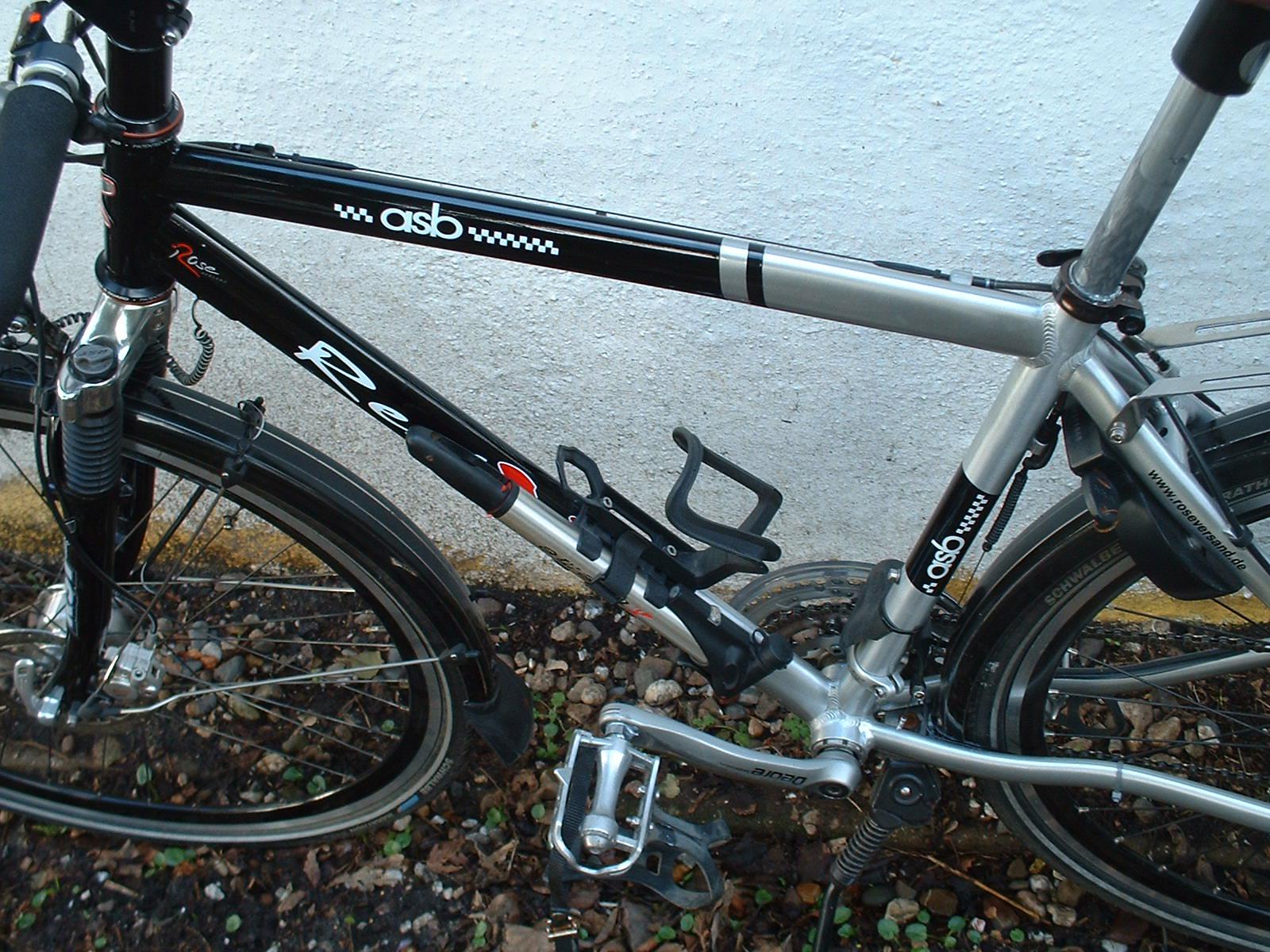
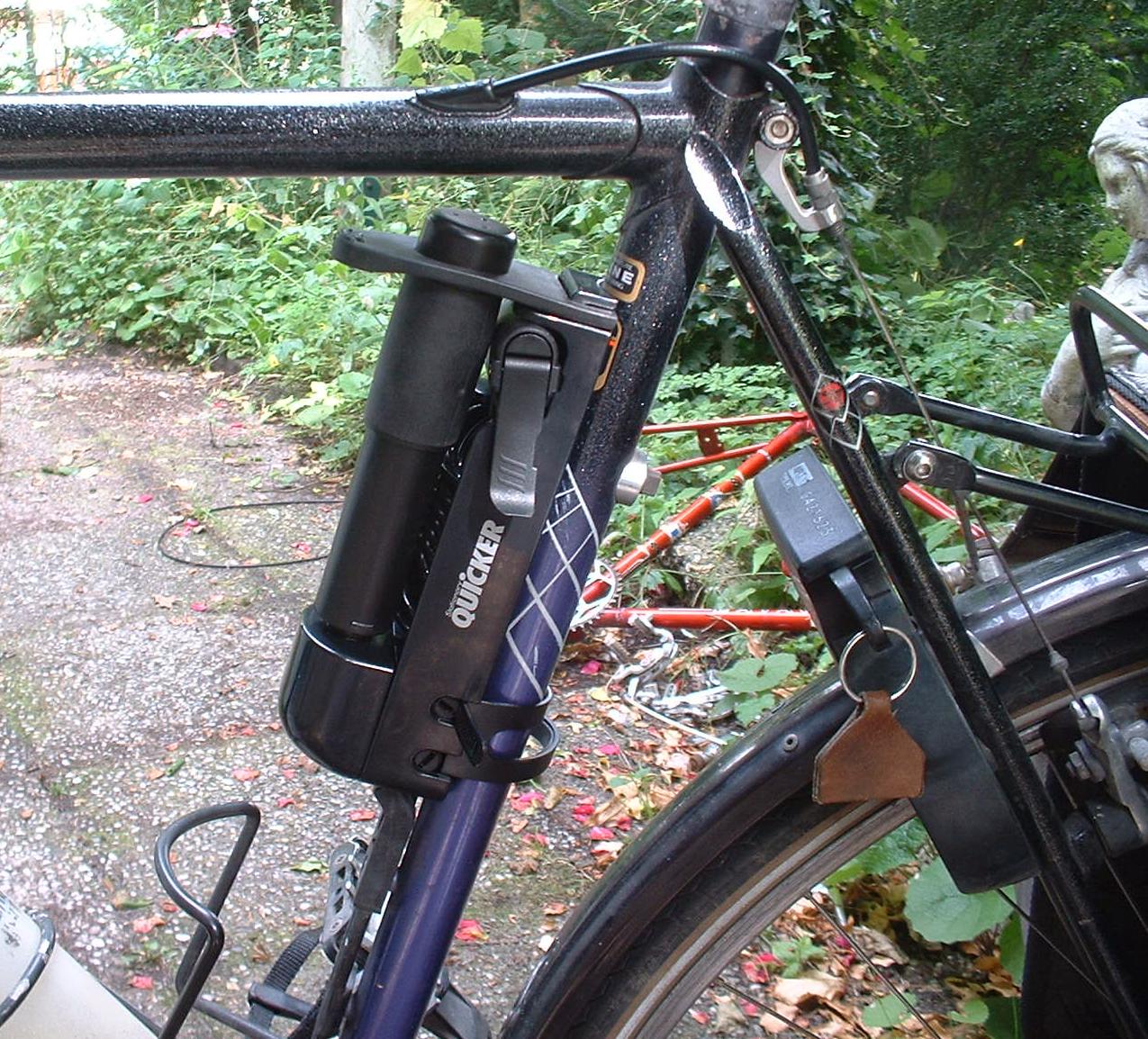
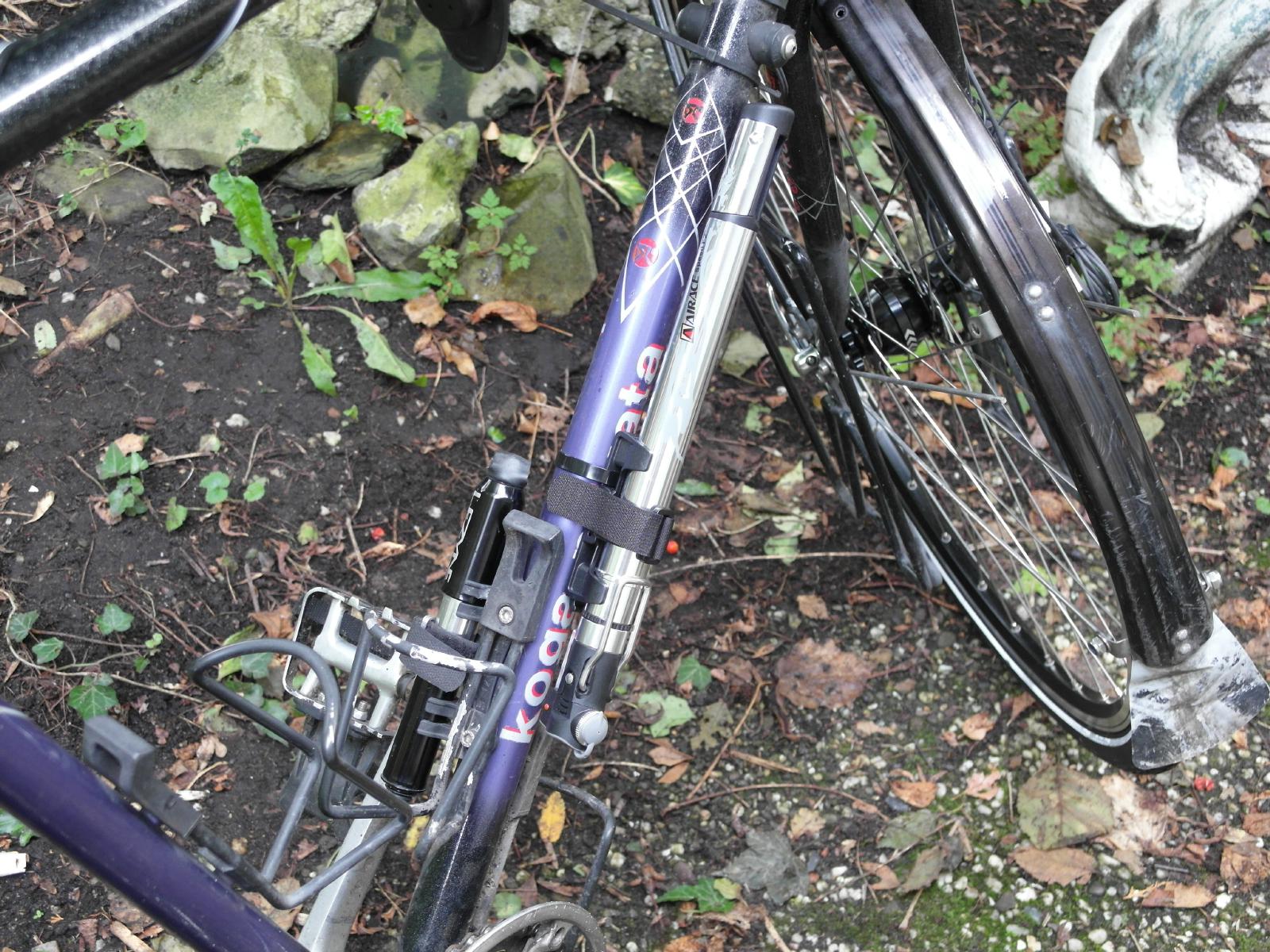
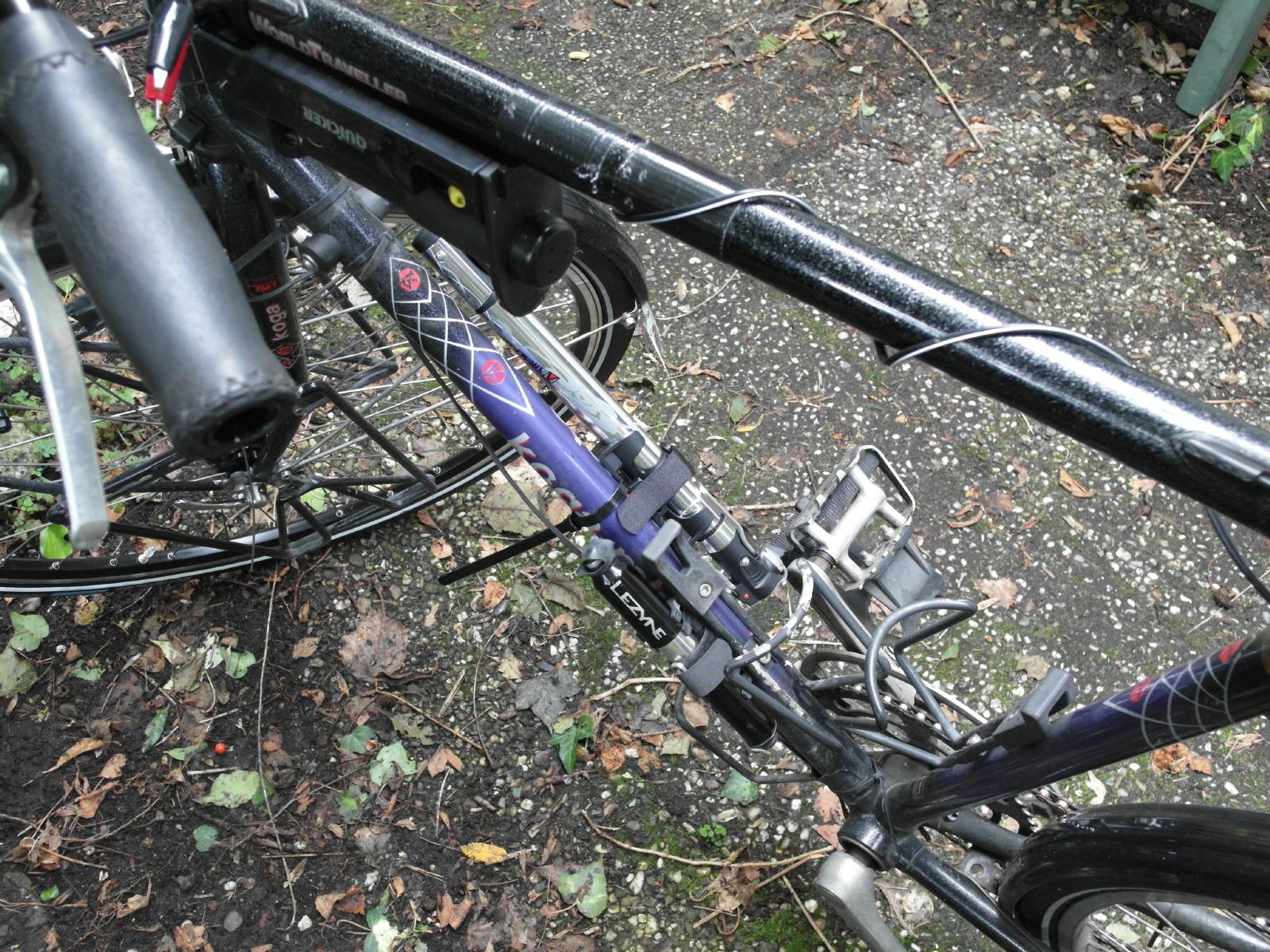
This is a test of bicycle pumps and related stuff I encountered (i.e. that I bought or I have regular access to), treated in a way it should be, dealing with issues I've not seen anywhere in tests in magazines and in particular in the Dutch magazine 'Fiets' (examples: the forces at play, pictures of the pumps on a bicycle, and letting a woman pump to see how far she gets).
Note: If I were to do this as a job (magazine writers take note!), I would test all pumps that seem interesting to me (see further on this page) and use properly (more accurately) gauged equipment (or gauge it myself) to give a good overview of all good mini pumps.
This page will be updated links, more details and pictures, depending on my interest and whether there's interest from others (it appears people visiting http://forum.fiets.nl don't care about true pump performance, weird, but also on bikeradar.com (UK) people just aren't interested in such serious examinations).
So, if you want to go against that current of apathy, and contribute, send me your comments, suggestions, or measure the piston diameter (=inner diameter of pump tube) of a pump not examined below in section 2 (using a caliper) and email me the results! Maximum achievable pressure can then be calculated with that. If you don't know how to open up a pump, measure the outer diameter of the pump tube, and I will estimate the inner diameter by presuming the tube wall thickness to be 1.0 mm, which it is in all pumps I've dismantled so far. This way a list can be made of pumps and pressures that can be achieved with them.
In the test below I mention that some people take out the wheel and put it on a rock to push against with the pump. I don't think that works as you need to find a suitable rock wich I've not seen on any of my routes or can be done possibly by carefully putting the wheel on a kerb, however in all cases damage to rims or even spokes is a clear possibility. Another method I was recommended is putting the end of the pump against your knee. This works pretty well I admit. What pressures I can achieve without it getting uncomfortable I will determine at a later date. To keep your clothes clean for this purpose you might want to take a little piece of cloth along.
First of all I will discuss the SKS Airchecker that I used to measure air pressure reasonably accurately.
Then a test of pumps that I encountered, with the pressure I can get with it, and with a few of those I asked my sister to pump up some tyres to see what pressure she can achieve. This is to get a picture of how much arm strength is needed and what pressure an average person can reasonably get to.
Next a list of pumps that may be of interest. I distilled this from other tests in magazines and user experiences on the internet (cycling forums mostly).
Then some calculations showing what forces are needed to reach a certain pressure, what pressure can be achieved with different piston diameters etc.
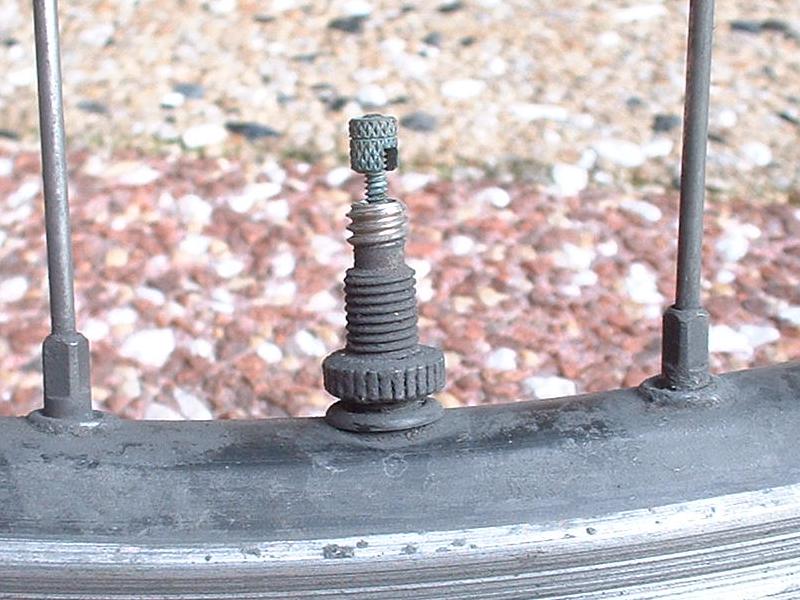
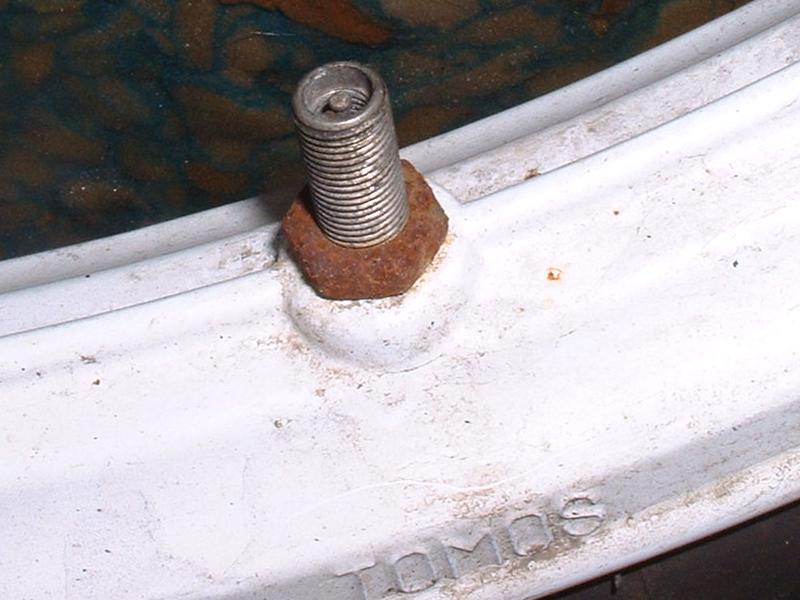
Valve types are known under multiple names:
Dunlop valve = Woods valve = English valve (and known as a 'Dutch valve' in the Netherlands as this is the most common type used here for city bikes):
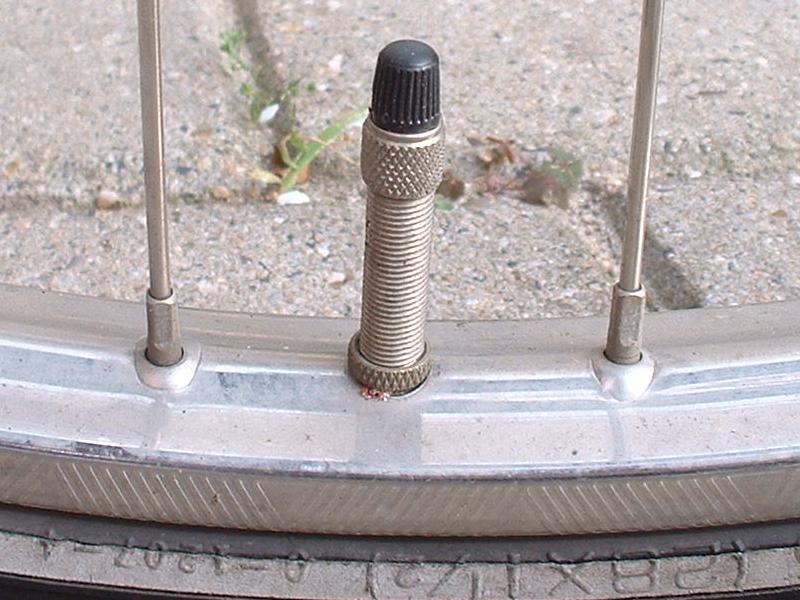
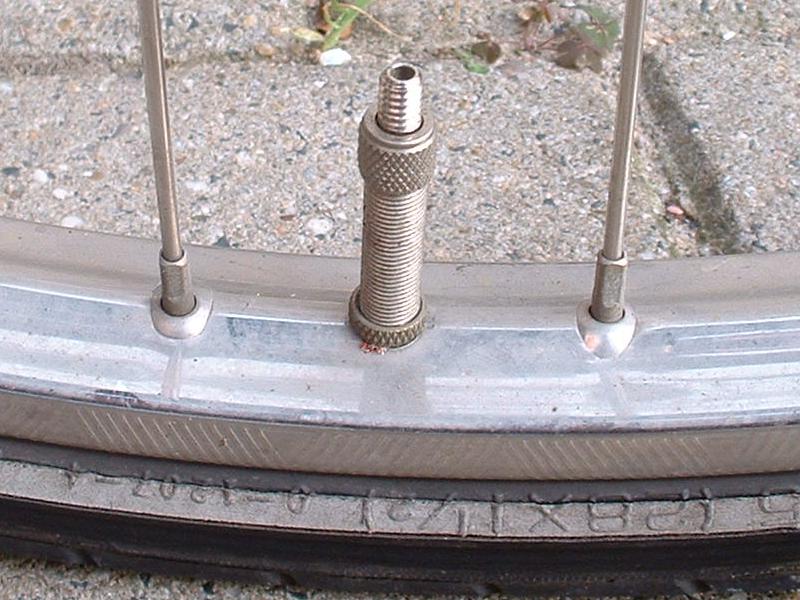
Presta valve = sclaverand valve = French valve:
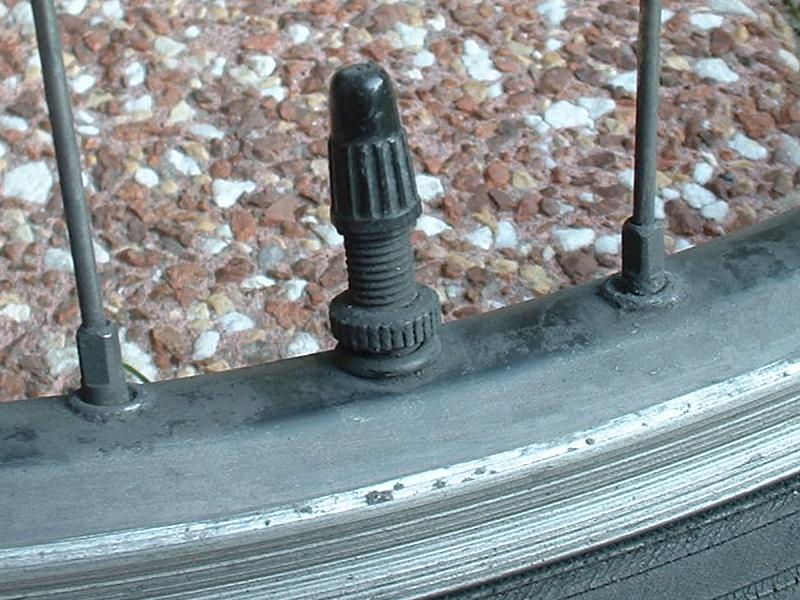
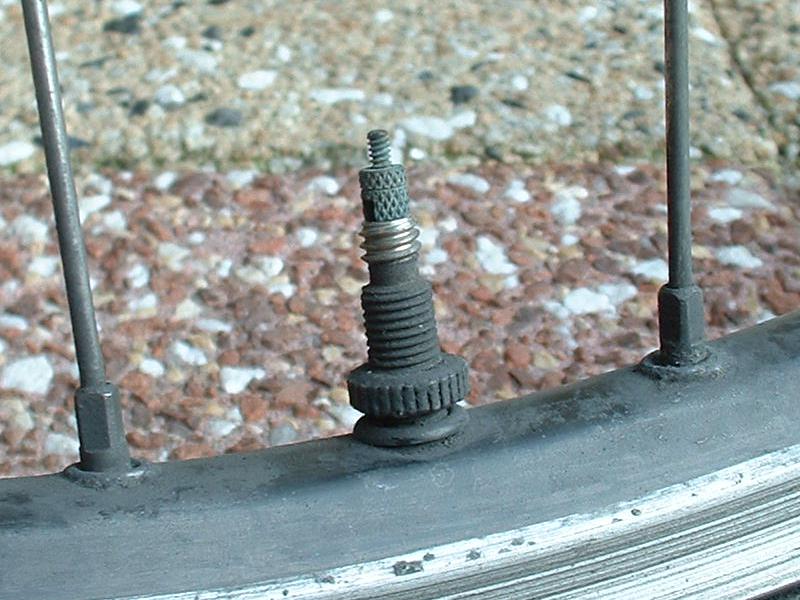
Schrader valve = American valve = car valve:

The instructions are rather poor. I first thought mine was defective as it only showed 0.00 bar, but you have to do the following: Turn it on, wait until the display shows 0.00 bar (this is also signified by a beep). Only then put the Airchecker onto the valve. In the beginning I put the Airchecker directly after turning on (before it showed 0.00 bar and beeped) or even before turning it on, onto the valve, and that just doesn't work. After that I had to experiment a bit such that the pressure is measured without the tyre deflating (with Presta valves at least). You must push the Airchecker hard onto the valve and keep it pressed like that. This is different from using the SKS Rennkompressor where you only need to press the rubber onto the valve and it stays put, that's not so with this device. After a short while you will hear a beep and the display shows the pressure. Putting the Airchecker on to the valve and removing it multiple times to measure again showed that the pressure loss with proper use is insignificant (measuring many times gave the same pressure each time on a road bike's tyre and city bike's tyre).
Measurement accuracy: According to SKS the displayed pressure differs deviates at most +/- 0.1 bar from the real pressure. The device shows pressure in steps of 0.05 bar, which in any case (despite +/- 0.1 bar possible deviation from the real pressure) gives a fairly accurate comparison (here I assume that the +/- 0.1 bar doesn't change within a small range, i.e. if 2.60 bar is measured as 2.50 bar, then 2.70 bar won't be measured as 2.80 bar; I won't discuss this here other than to say that that such fluctuations are improbable).
With this device I had a look at how much the pressure gauges on my SKS Rennkompressor and a Profile floor pump (see the section on floor pump) deviate. The Rennkompressor shows pressures at 0.35 bar too high (measured at 2.0 / 3.0 / 4.0 / 5.0 / 8.0 bar, in which cases the Airchecker displayed 1.65 bar / 2.65 bar etc.), the Profile floor pump showed pressures at 0.7 bar too high (also at low pressures), which is quite a big deviation.
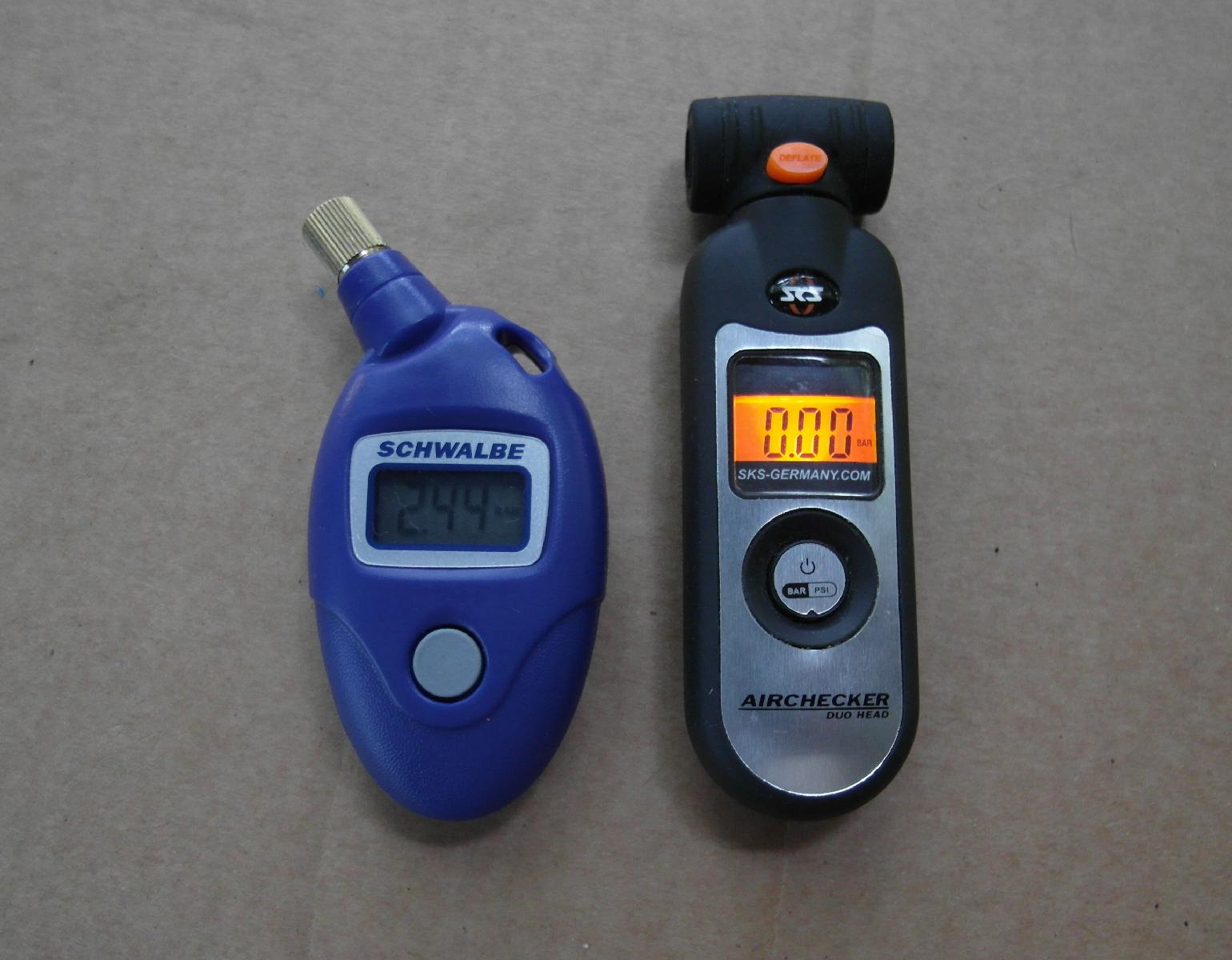
The instructions are inadequate, as with the SKS Airchecker, but I could work it all out without using the manual. The last measured pressure is kept in the display/memory, even when it switches off. The gauge beeps a few times to warn that it goes off. I'm not sure this is useful. To measure a second time you need to reset the gauge while it's off the valve, by pressing the button for a short time (this is not mentioned in the instructions). The display shows CLE and then you need to let go, keeping the button pressed longer switches the Airmax pro off. I prefer the shape of the Airmax pro to the Airchecker, it's also slightly lighter (35 g vs 44 g) and the rotating head on the Airchecker just means too many times I find myself thinking "how do I need to rotate it to be able to read it without turning the wheel?". It's quicker to use a fixed gauge and rotate the wheel when needed. I also prefer the shape in my hand of the Airmax pro although the housing feels cheap and creaks when holding it. For Schrader valves you need to unscrew the brass head which is for Presta valves. Will the plastic housing hold up when doing that a lot? Will you mislay the adapter? Checking a few tyres the values the Airchecker and Airmax pro give are very close together. The Airmax pro shows pressures with 2 decimal places, so per 0.01 bar, although the gauge is almost certainly not that accurate. The Airmax pro doesn't have background lighting. This is not a downside to this device for me as I never needed it with the Airchecker.
I will start with the best pumps and end with pumps I used too, but don't recommend. I give each pump a BSF value (BullShit Factor) that signifies how ridiculous the assertions about the pump are with respect to the achievable pressure.
As to pressure one can achieve, I suggest the following maximal/standard values for the forces (see the pump reviews to understand why I chose these values), to determine what pressure an average man/woman can get with a given pump. Here I distinguish between a pump that's put onto the valve and a pump that's attached to the valve with a hose:
| Pump type: | Maximal force: | Standard force: |
|---|---|---|
| Pump attached to valve | 118 N (12 kg) | 118 N (12 kg) |
| Pomp with hose | 177 N (18 kg) | 147 N (15 kg) |
N.B. This will be adjusted a bit, as it's now clear that with longer pumps (which are no longer mini-pumps) you can apply much more force (which I actually already knew as you can see from the comment with Lezyne Road drive M where I compare it with the Pressure drive S). See for more information the test of Rose Versand's 'Xtreme Big Volume' pump.
For a woman I assume 2/3 of these forces are reasonable (see the test of the Lezyne Pressure drive as to why) which gives the following forces:
| Pump type: | Maximal force: | Standard force: |
|---|---|---|
| Pump attached to valve | 78 N (8 kg) | 78 N (8 kg) |
| Pomp with hose | 118 N (12 kg) | 98 N (10 kg) |
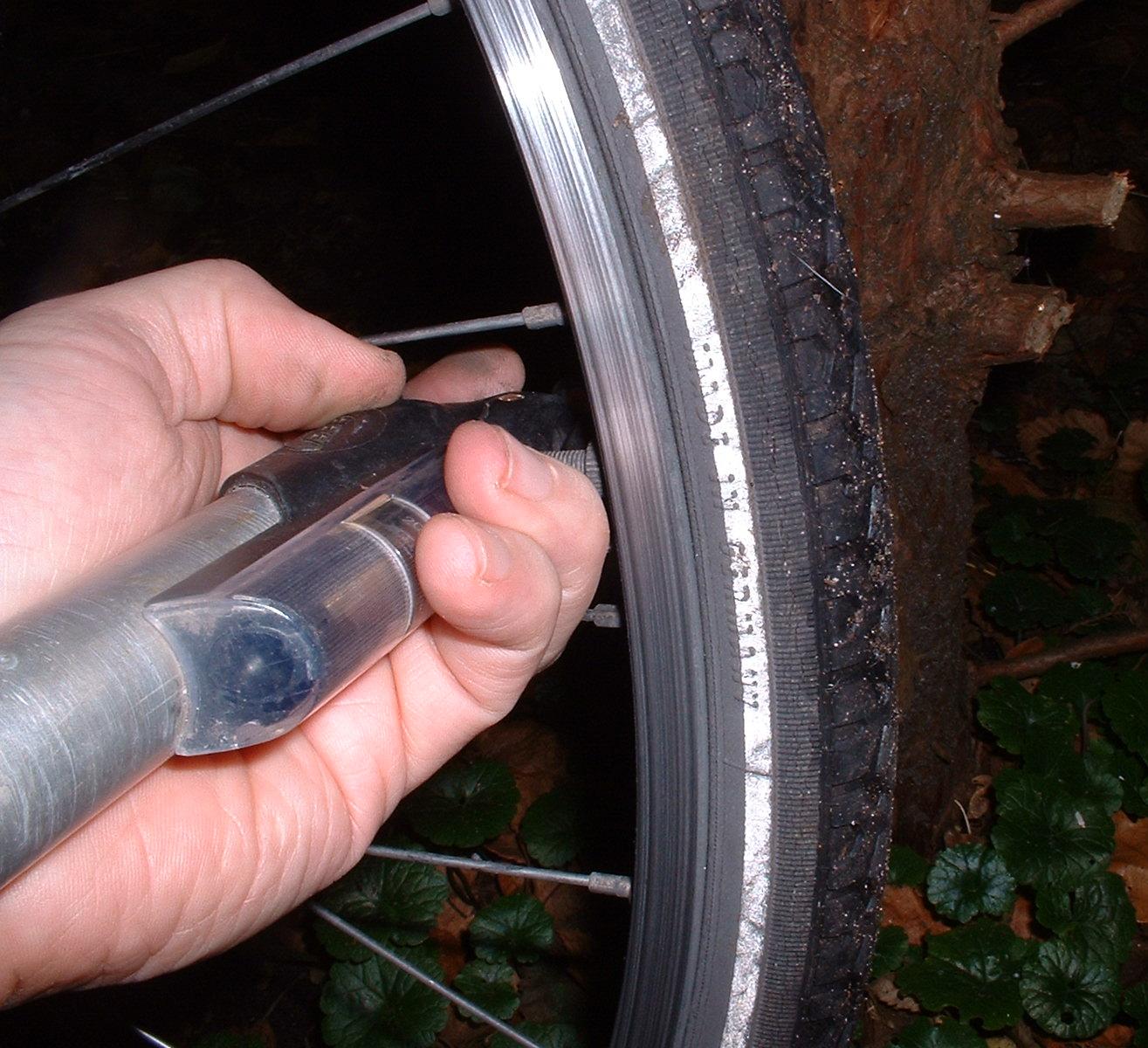
I've chosen the maximal and standard forces to be equal for pumps that are directly attached to the valve, because the spokes already limit one very much, so there's no need to limit the force either to reduce the risk of damaging the valve (or spokes), or to prevent possible injuries.
This shows the problem that limits the force you can safely apply with 32/36 spoke wheels:
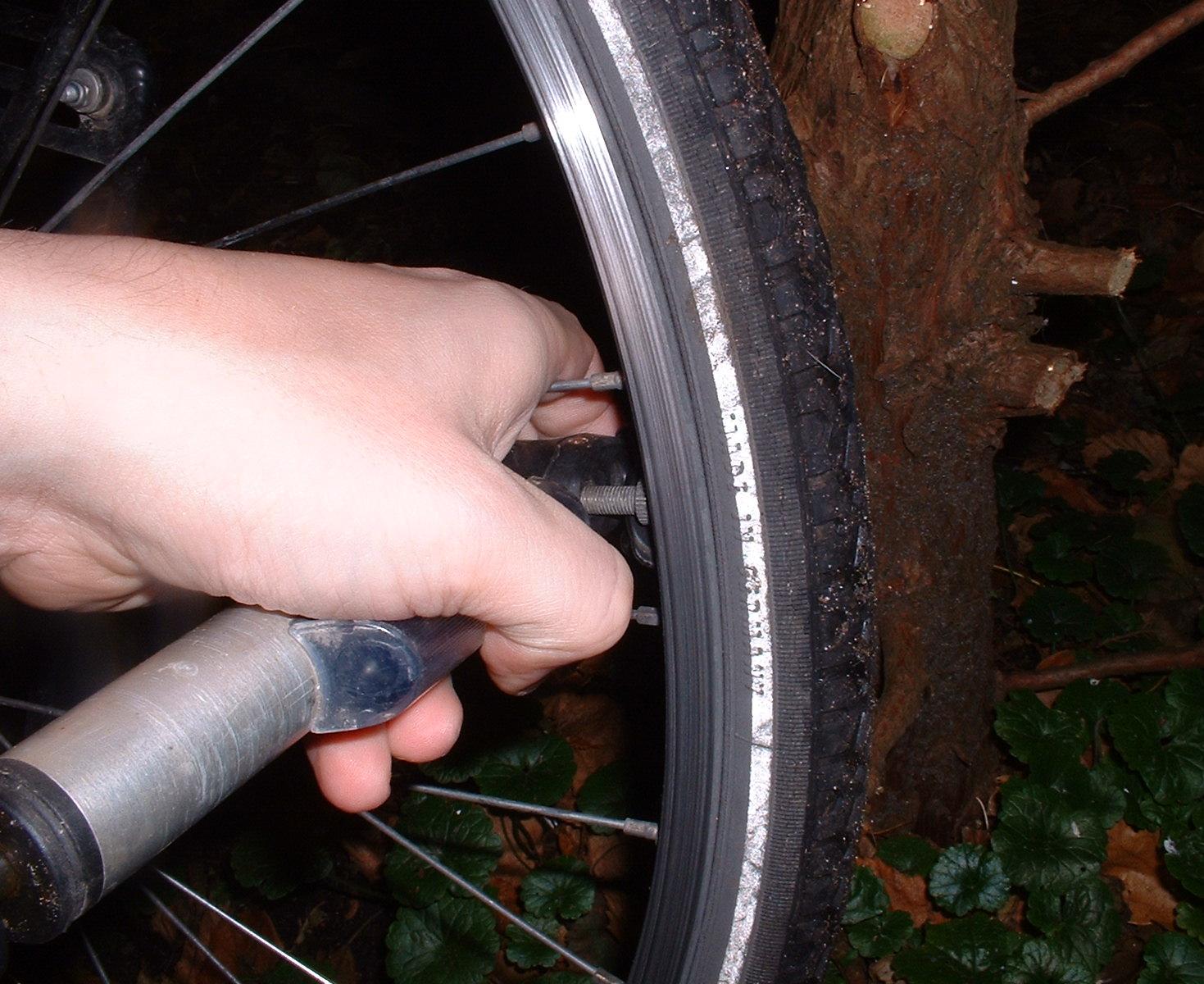
Ratings are given for each pump taking into account the pressure it can reach (if not enough, then it will always get a low grade, pumps that can't reach 3.5 bar, which is the minimum for city bikes, get a rating of 0), weight, size, looks, quality.
A pump needs to be able to pump to different pressures depending on tyre type/width. For road bikes: ca. 8 bar. For mountain bikes: ca. 3 bar. For city/touring/travelling bikes: ca. 4.5 bar.
|
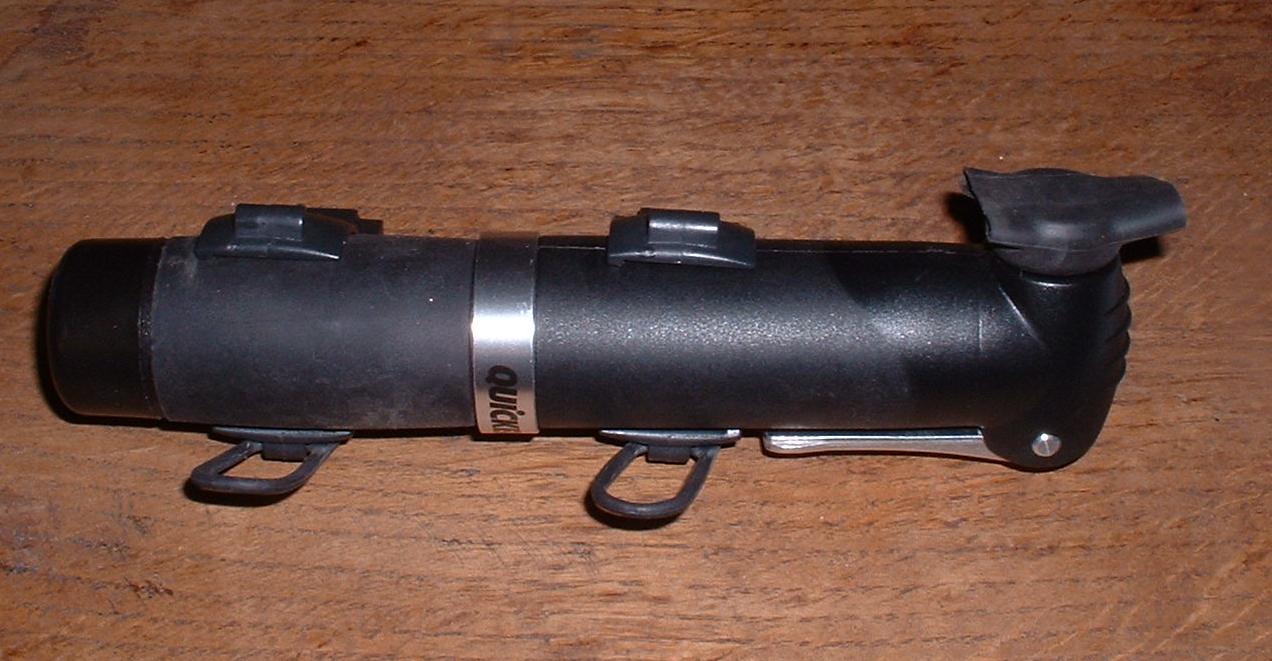
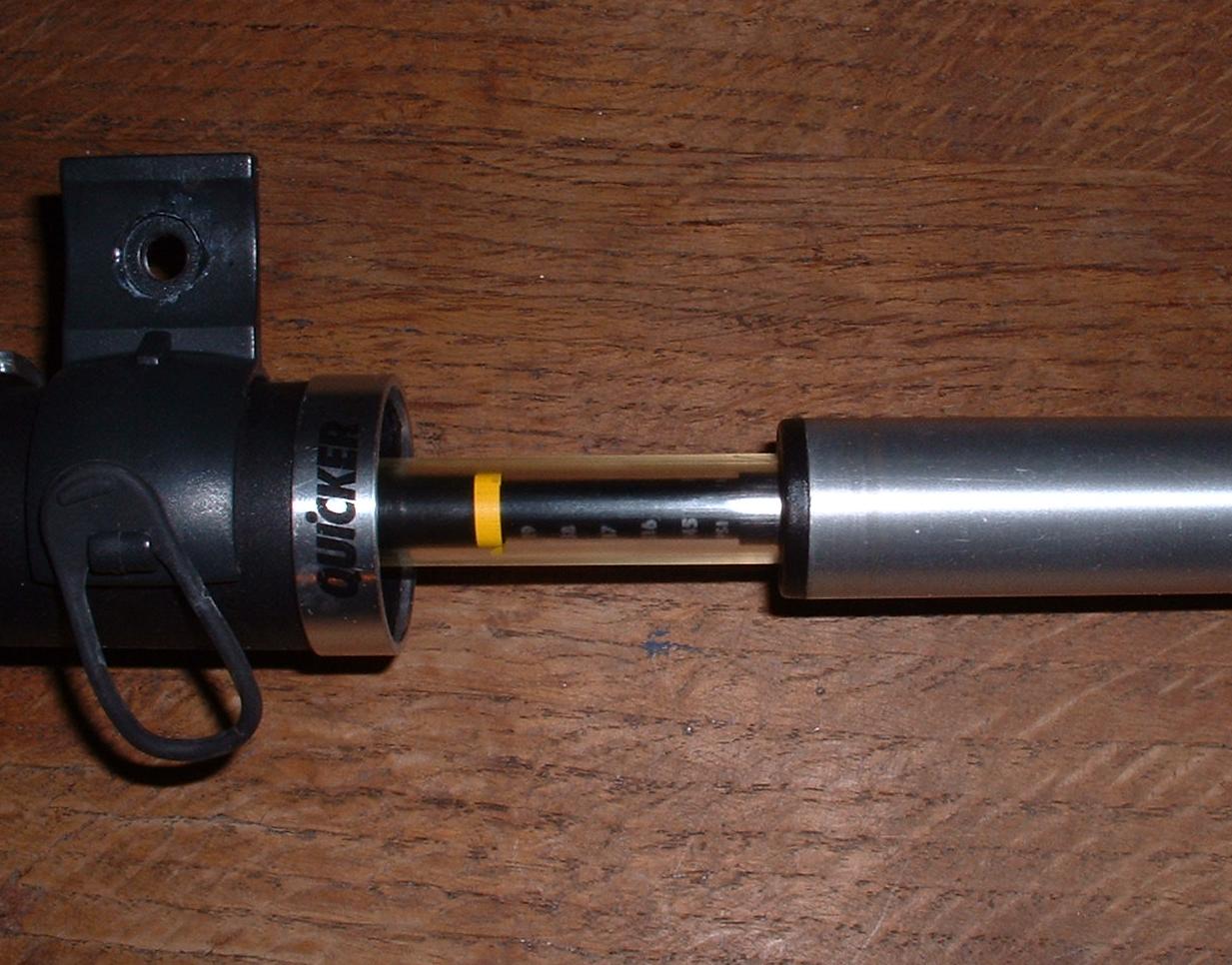
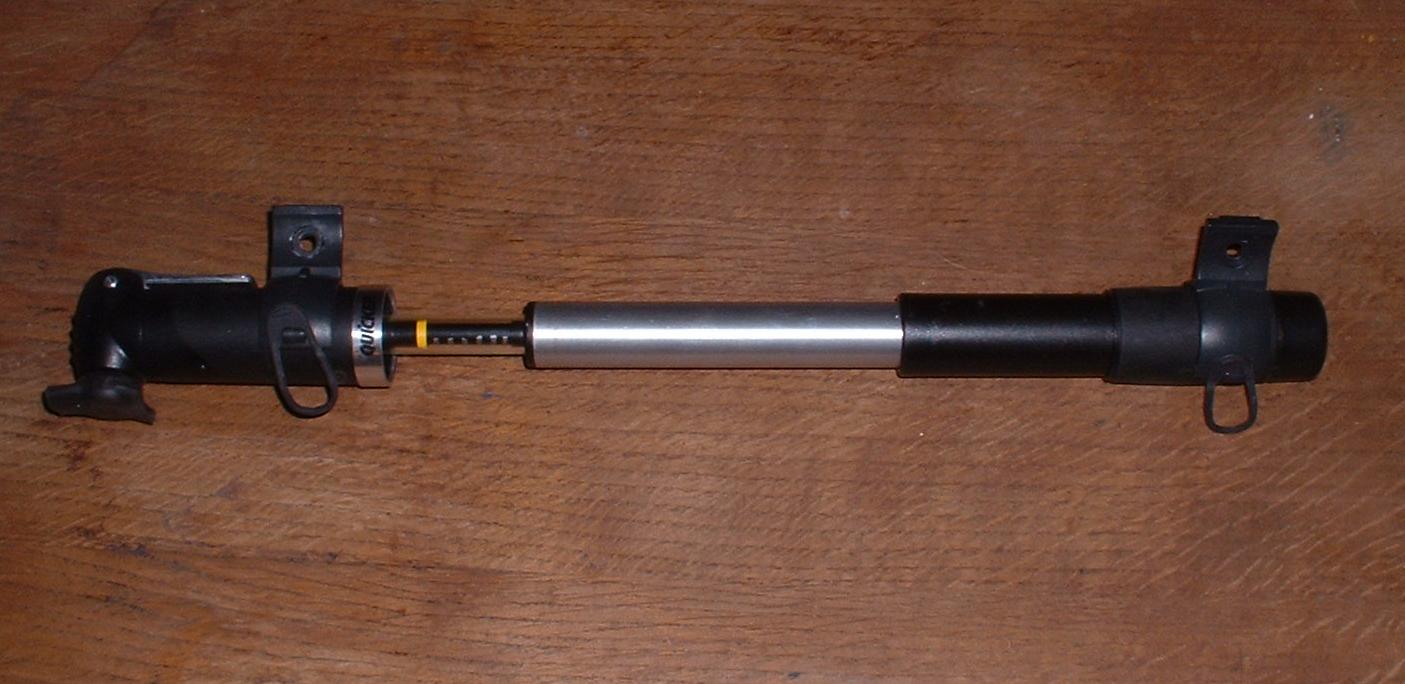
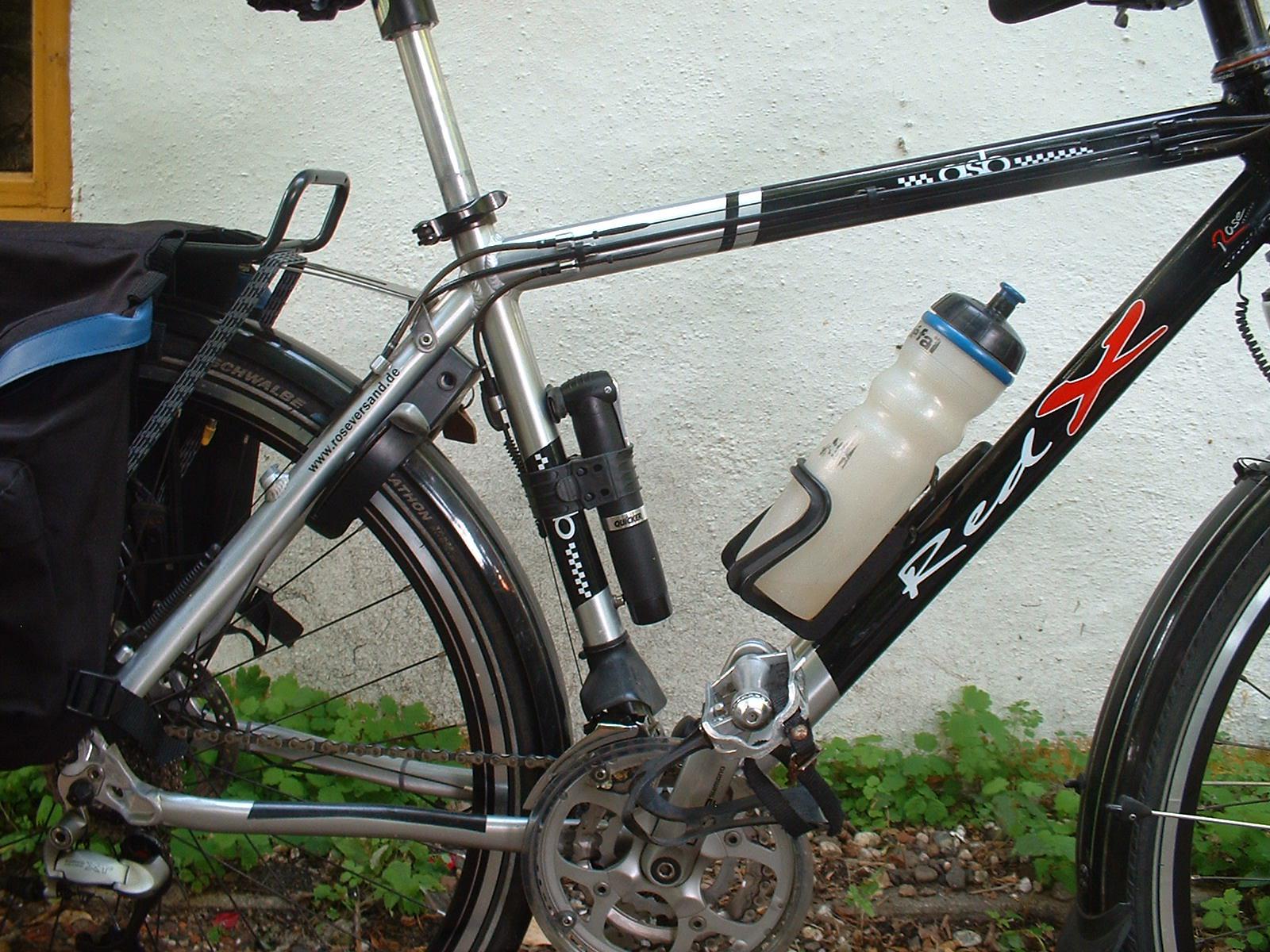
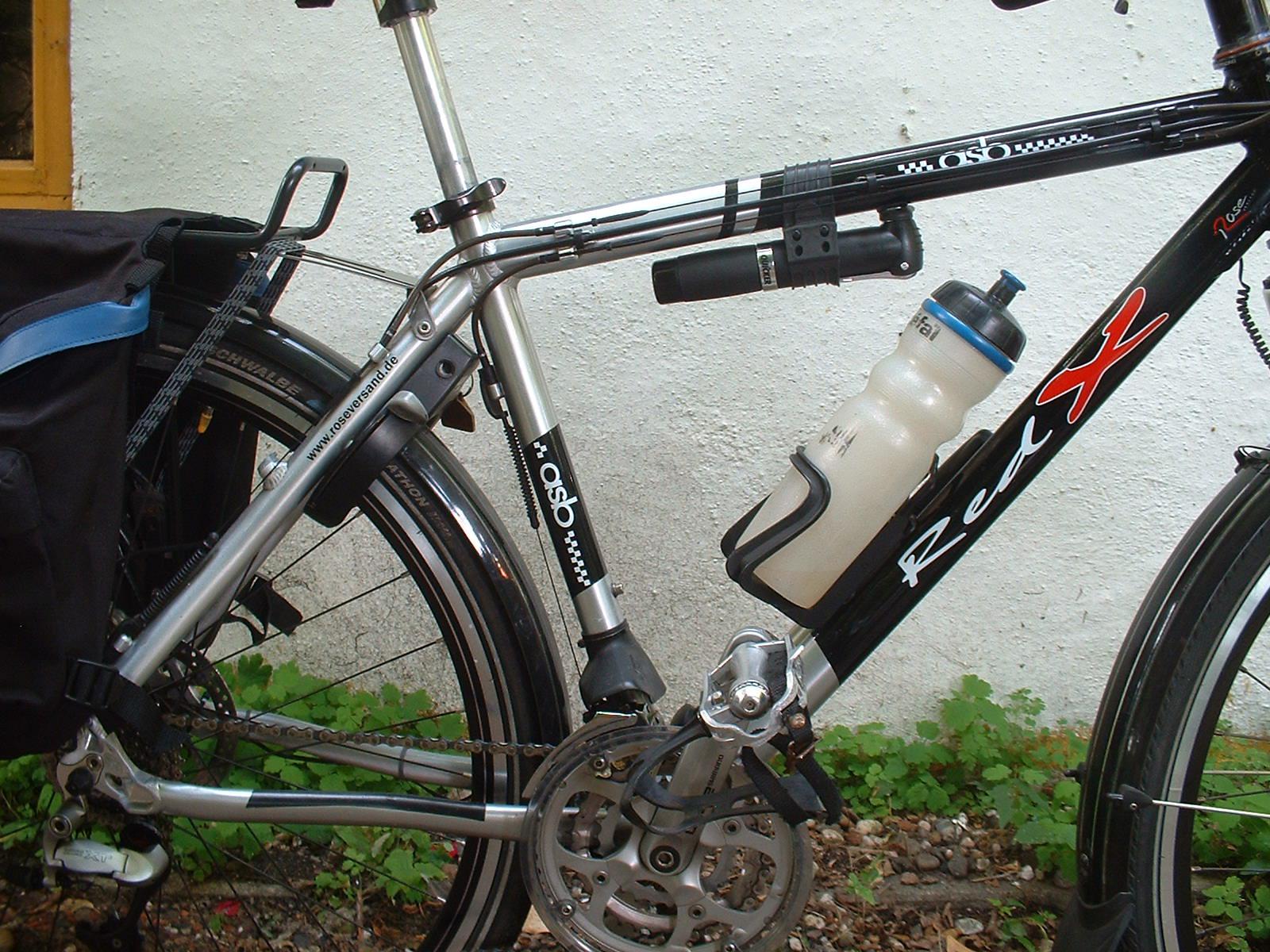
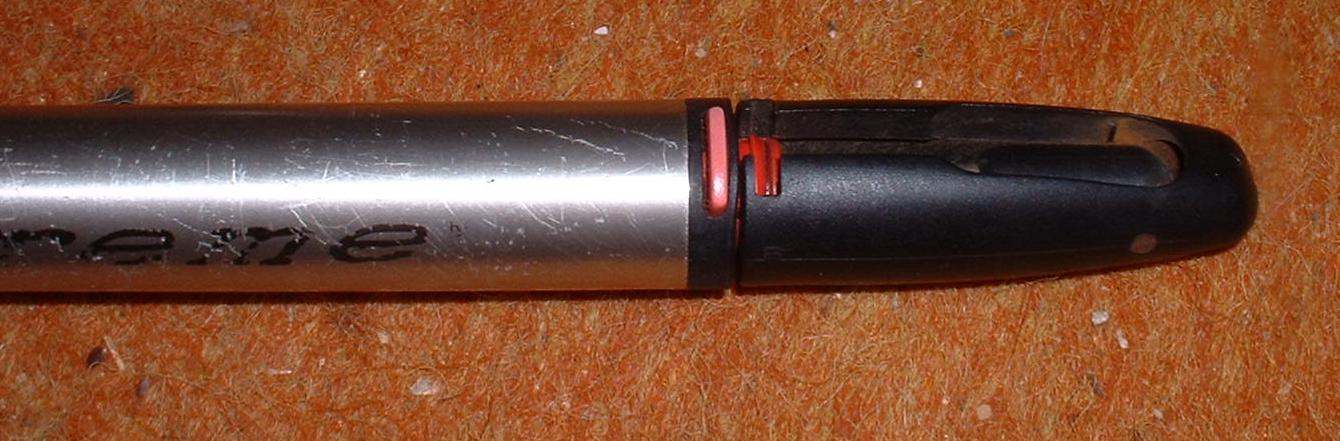
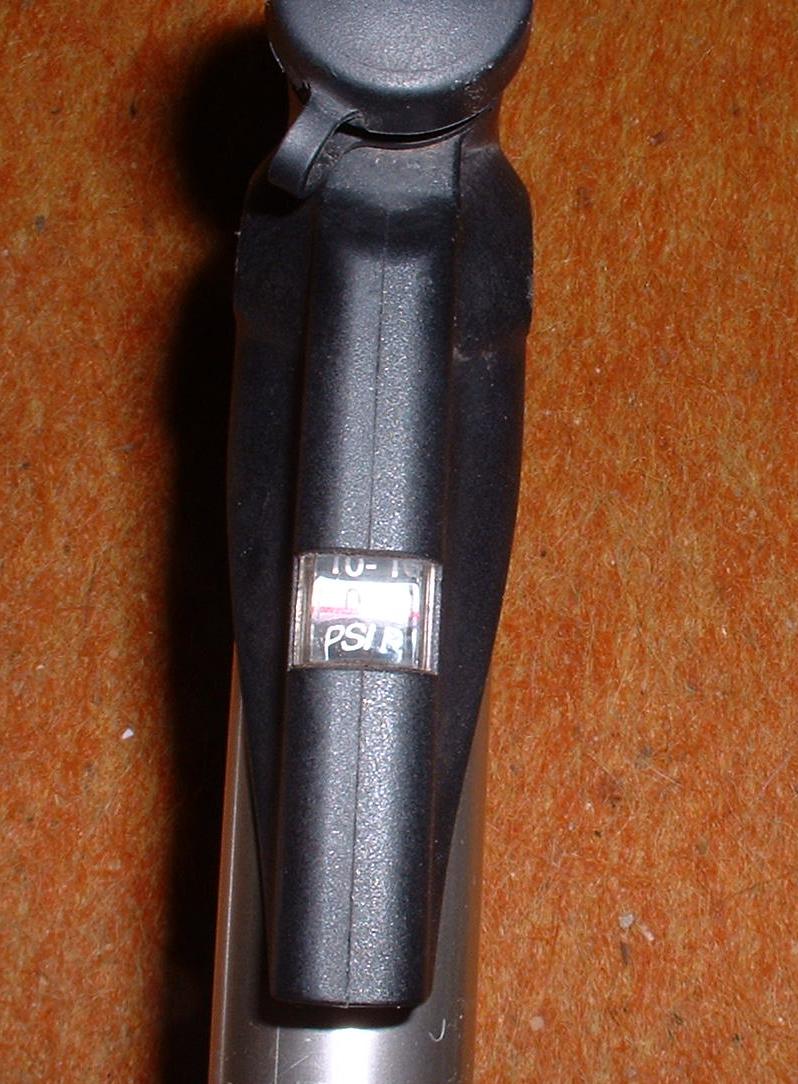
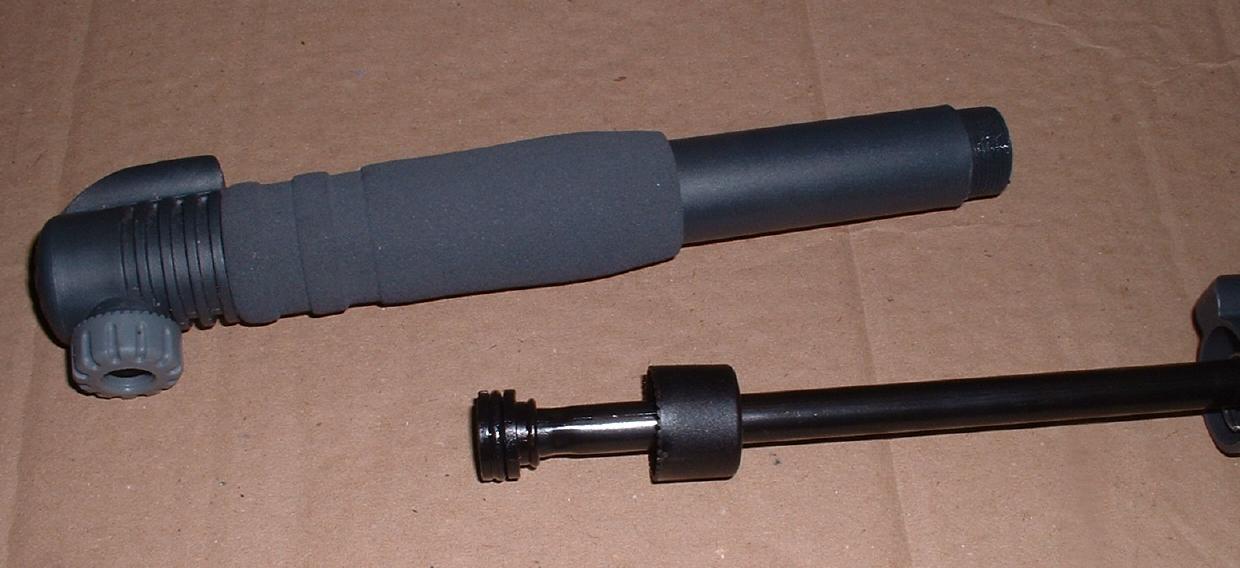
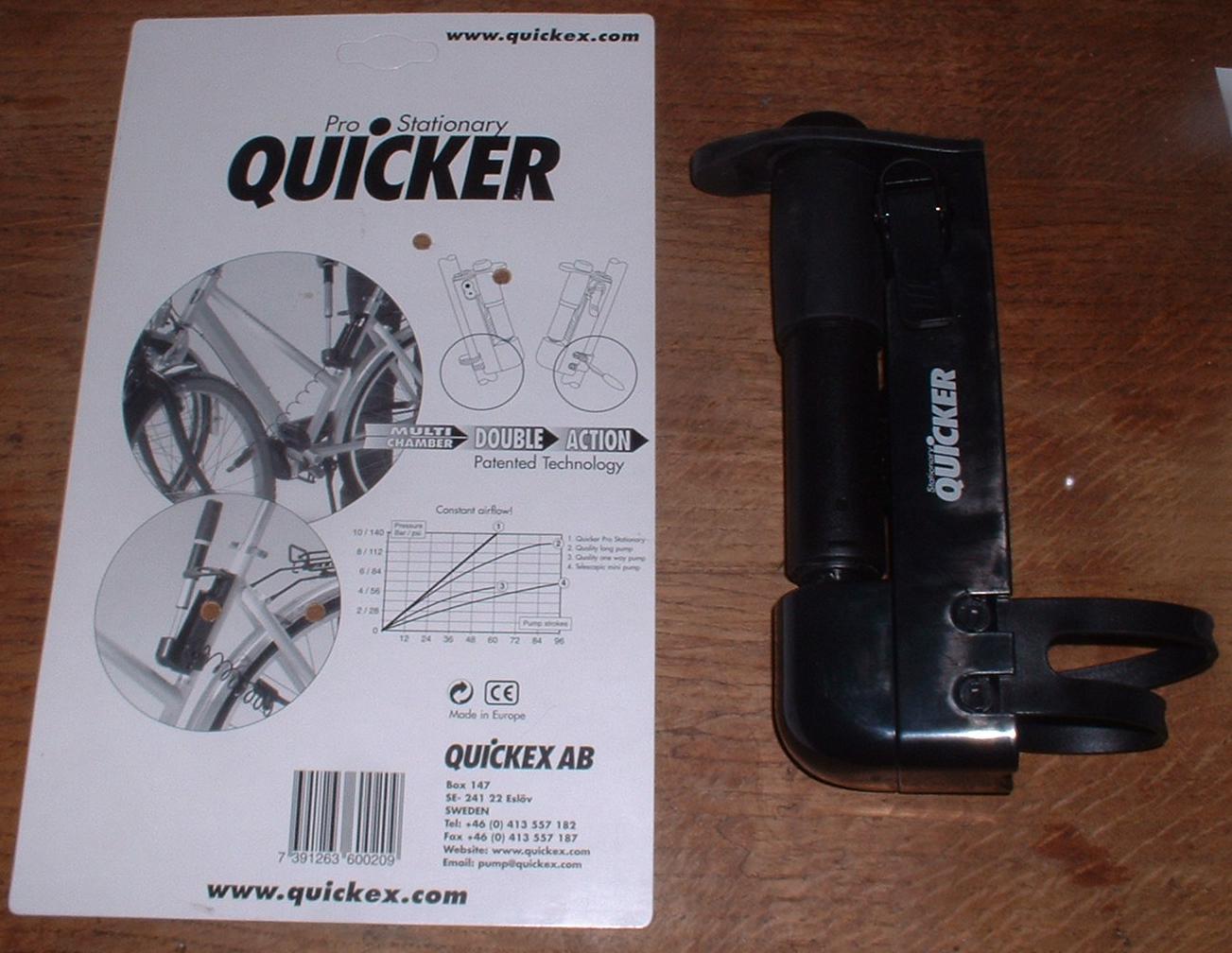
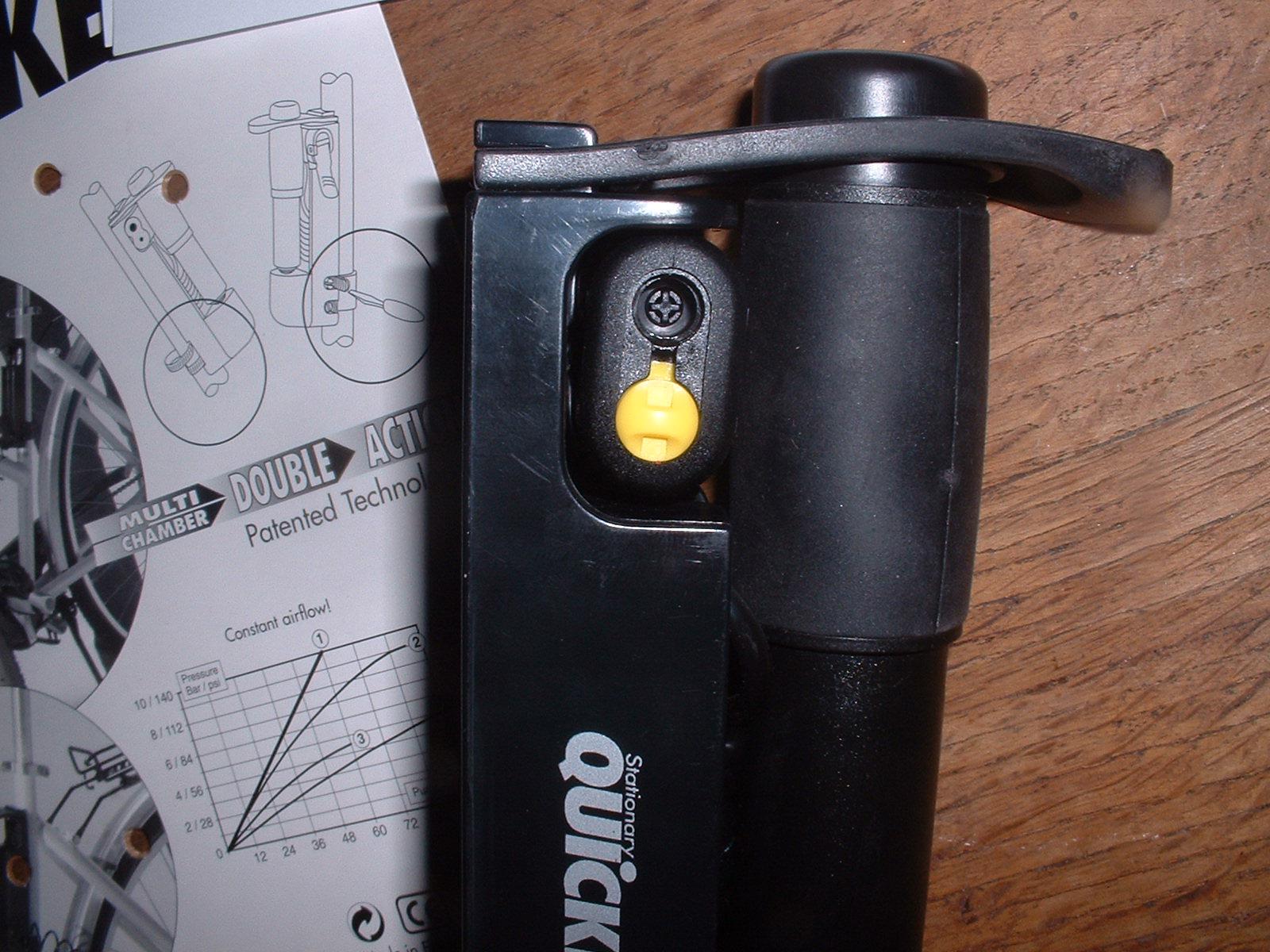
Claimed pressure: 12 bar (later versions apparently 11 bar, I'm not sure anything was changed in the pump). The pressure can be read within the inner cylinder, which you need to do when you pull the pump out, this gives a brief moment at which you can read the pressure, but it works pretty well. You do have to point the wheel/valve such that you see the bar and not PSI (come on, let go of those archaic 19th century English units). I pumped up the tyres on my road bike several times to about 7.50 to 8.45 bar (I just quit when the pressure gauge of the Quicker pro indicated a pressure I felt was adequate). This was so simple, that I give the instructions (which now say the pump can go to 12 bar, with a previous version (or later version?) it was 11 bar, not sure if they changed anything in the pump) a BSF = 0. I'm not sure if 12 bar is really possible with normal effort, because I don't have any tyres that go to 12 bar, but the required force at nearly 8 bar is so low, that 12 bar seems possible. I had my sister pump up a tyre and she got to 4.70 bar. More was possible (she felt it was going easy) but she still had a sore shoulder from the test with the Lezyne Pressure drive so we stopped here. To be continued... The innermost cylinder has an outside diameter of 13.45 mm. The inner diameter of this cylinder is probably about 11.5 mm. This means that in case the pump sends air to the innermost cylinder last (i.e. the larger cylinder moves first, the smallest cylinder then moves and air is pushed through there and only the piston in that smallest cylinder moving), then with normal force it is possible to pump up to 14 bar, so, with less than what I consider to be 'normal force' (= should be no problem for any man) 12 bar can be achieved. This would also mean a woman should be able to reach at least 9 bar with 'normal force'. It seems that the pump works precisely as I assumed above, with openings per cylinder that only open when the previous cylinder has travelled its length. Further, on their website Quickex mention the forces required to pump to 7 bar with the Quicker pro and other pumps that underline this. They say that for 7 bar, you need to apply a force of 5 kg (or more accurately, they mean the equivalent force to lifting a 5 kg mass [ mass is not force, although it's usually measured with a force! Hence the confusion in daily use between mass and weight ]), while other pumps need 17 to 20 kg to reach 7 bar. This is reasonably close to my findings with an inner diameter of 11.5 mm. The (estimated) 11.5 mm inner diameter means a force of ca. 73 N (7.3 kg) at 7 bar, and a pump such as the BMP-17 Windgun even needs 29 kg for 7 bar (only possible for weightlifters!), the Lezyne Pressure drive comes to around 210 N (21 kg). Btw, I manually tried the trick of first having the large cylinders move, several years ago using the Zefal Mini double shot, but it didn't work there because the rubber seals don't hold above ca. 3.15 bar
Switching between Presta/SchraderThis is a bit of work, you need to unscrew the aluminium ring, then use a small screwdriver or similar to pull out the plastic bit inside the head (this can take a bit of work), turn it over, and reassemble the pieces in the order as shown on the back of the cardboard. Then screw on the aluminium ring again, carefully, as the thread is fine and can be damaged by crossing the threads and screwing it on at an angle. Negative points are
Conclusion: Fantastic pump for any type of bicycle. Fairly small (short, but pretty thick) but a bit heavier than the ultra lightweight pumps. |
|
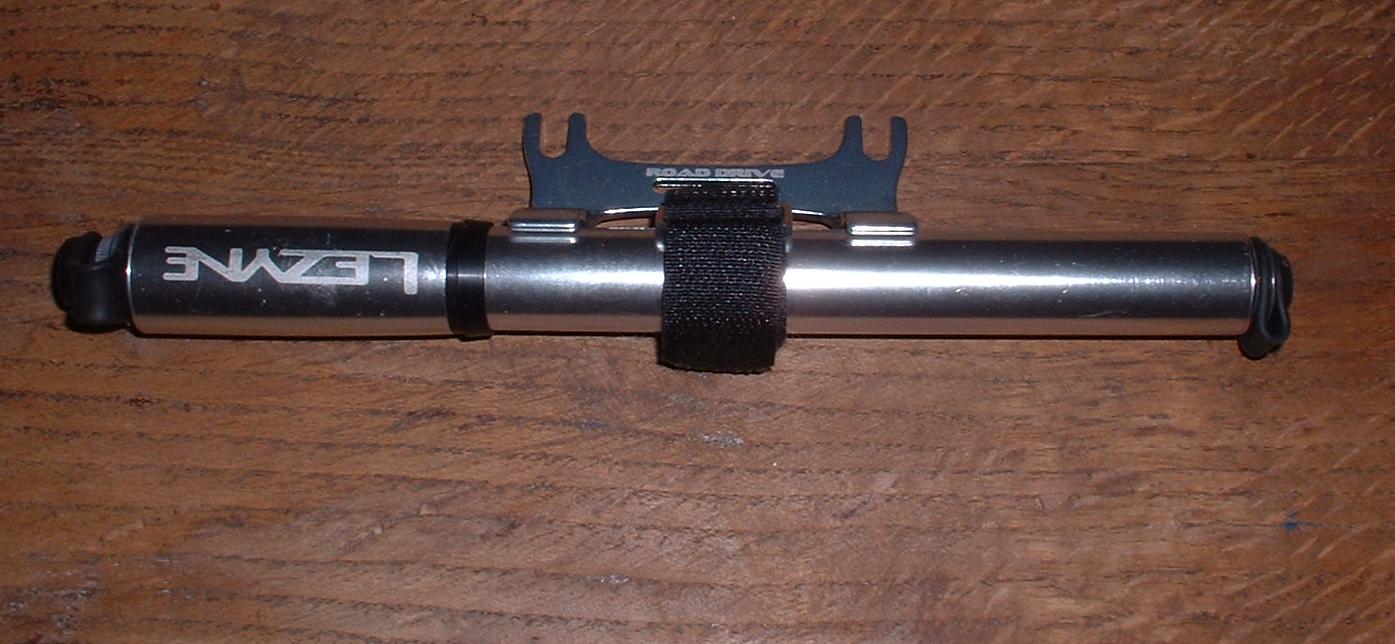
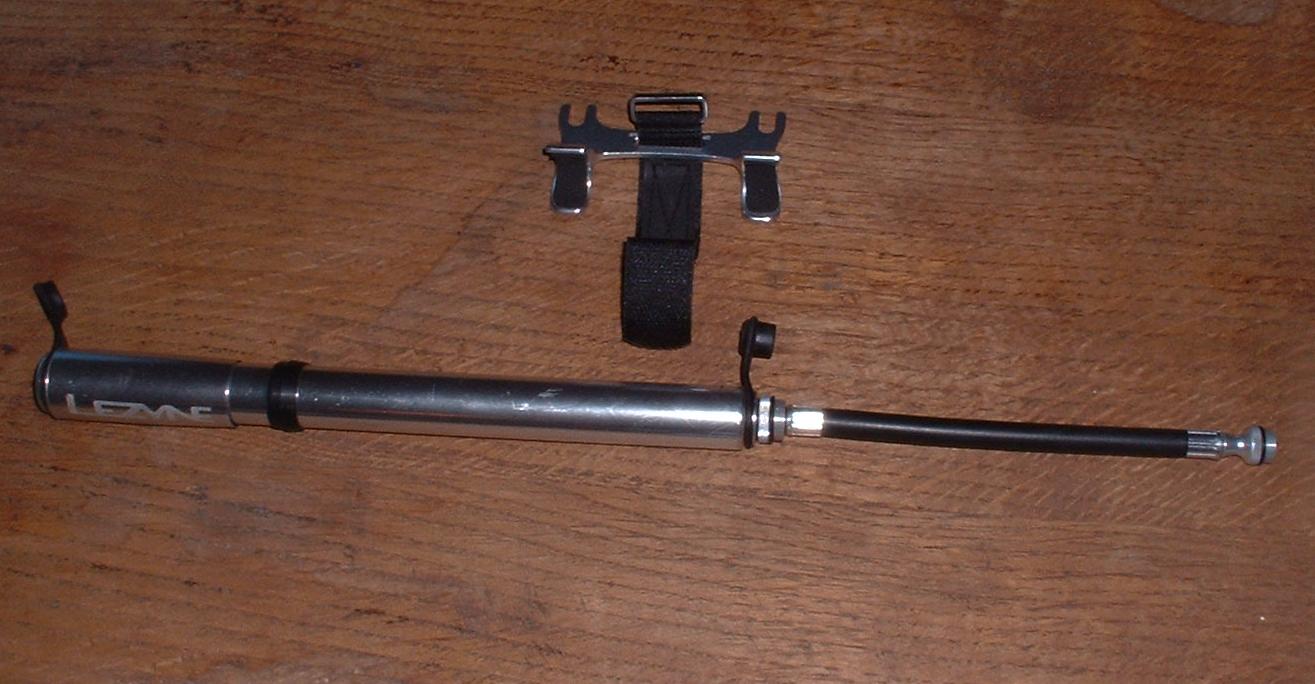
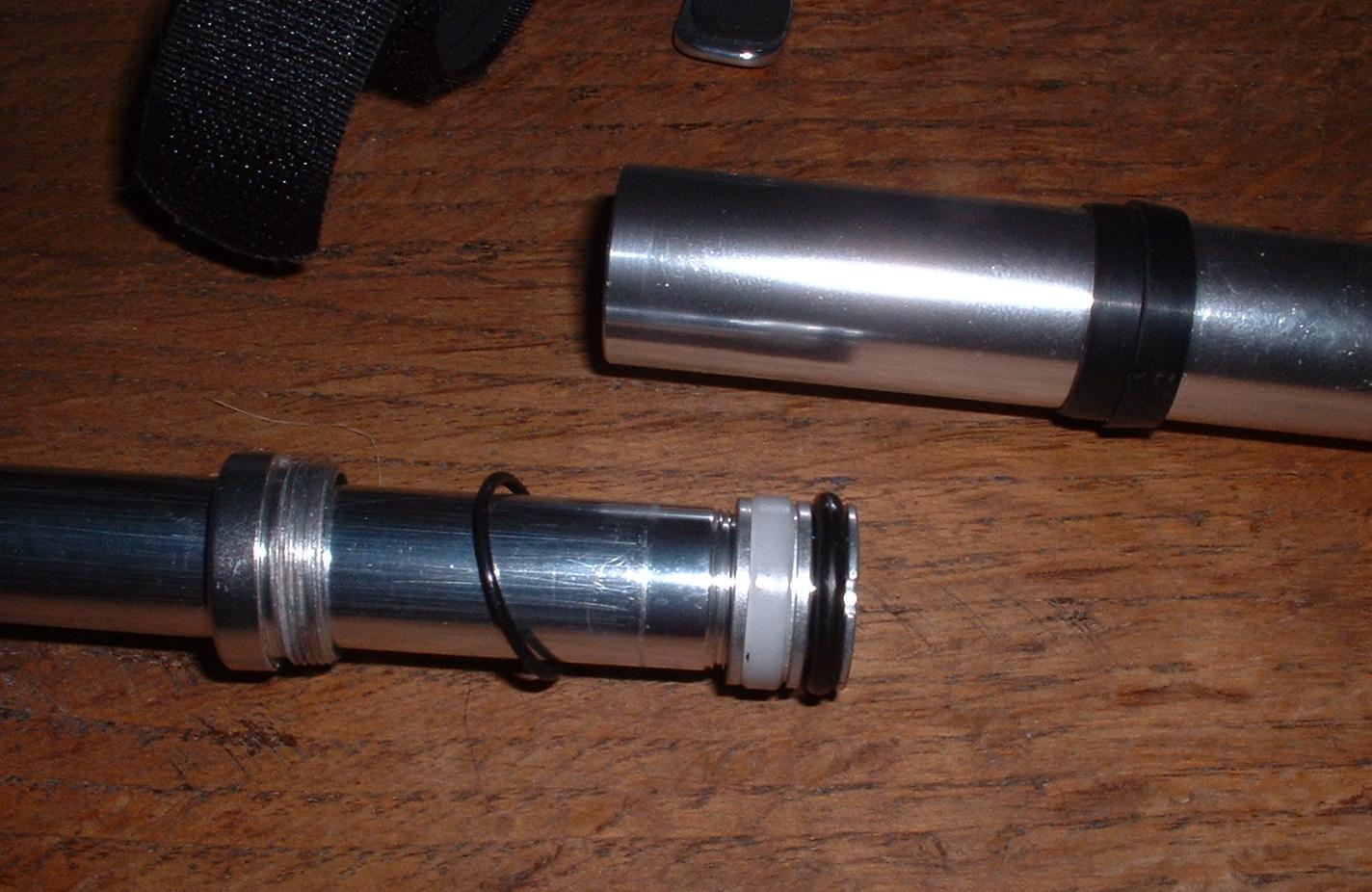
Claimed pressure: 11.0 bar Tested: Spring 2009. Use: unscrew the hose from the pump body, then screw it onto the other side of the pump and screw the hose on the valve (You may find it easier to first screw the hose onto the valve, then the pump body onto the hose). Note that a separate hose for a frame pump is not a new idea. I remember having seen these in the late 1970s, and you can see an example in an episode of 'Bottom' (Rick Mayall & Adrian Edmondson) from ca. 1990... Up to about 4.5 bar it's easy going, then I feel the strain in my elbow joint which is not a good thing although up to about 5.5 bar it's easy to pump w.r.t. the force needed, after that it gets a lot harder and it really ends before you reach 8 bar, unless you are prepared for extreme effort. I got to 8.05 bar, and I could, muscle wise, get even higher, but I won't as I can feel the high strain in my elbow. In other words, applying such force in the way it needs to be done when pumping, is not good for you, and can lead to injuries. It's a bit easier going than with the Pressure drive S (at the same force I mean), I think that's because the Road drive is a little longer, which gives a somewhat better position of the elbow while pumping. I used the rubber caps on the pressure drive but these deteriorated too, so see the pictures there of what happens. The rubber stuff and seals are problem areas in Lezyne pumps from reading a few experiences of other people recently (2016)...
Negative points are:
Conclusion: Fine for a road bike. Nice to look at and the small diameter makes it inconspicuous on a road bike. Also suitable for city bike or ATB/MTB (if it has Presta valves). Schraeder valves are also possible if you exchange the hose for the standard Lezyne hose that also has the complete Schraeder head. But, the price is fairly high and that doesn't give you a pressure gauge. This means, all things considered, that this pump is fairly expensive for what you get. If you're not a weight weenie and want a pressure gauge, use a Quicker pro which also allows you to pump easily beyond 8 bar. Rating: 6.5 (as with the pressure drive decreased 1 point, this time from 7.5, because of the end caps that deteriorate) I'd like to see the following: The Pressure drive M but a smaller diameter such as the Road drive (or even slightly less), with plastic pump holder as with the Pressure drive (te keep the price down), and hose with Presta/Schraeder heads for the same price of the Pressure drive, or even better, with a pressure gauge (the 'pen gauge'), for a small increase in price compared to the Pressure drive (ca. €40,- maximum). |
|
Claimed pressure: 8.3 bar. Tested: Fall 2008. Use: unscrew the hose from the pump body, then screw it onto the other side of the pump and screw the hose on the valve (You may find it easier to first screw the hose onto the valve, then the pump body onto the hose). Note that a separate hose for a frame pump is not a new idea. I remember having seen these in the late 1970s, and you can see an example in an episode of 'Bottom' (Rick Mayall & Adrian Edmondson) from ca. 1990... Until about 4.5 bar it's easy, after that it gets much harder and at 6 bar it really ends unless you are prepared for extreme effort. Regarding the 8.3 bar that Lezyne says one can get to with this pump: The seals will probably hold, but you have to be either Arnold Schwarzenegger to get to that pressure or take care that you don't get a sore shoulder, or even a real injury. My sister got a tyre up to 4.15 bar, but after that she had some pain in her shoulder. I as well by the way, after pumping a road tyre to 6.10 bar. One has to be very careful not to make a wrong move or even injure oneself at the forces needed for this pressure.
Negative points are:
Conclusion: Excellent for mountain bike or city bike (if they have a Presta or Schraeder valve). Usable on a road bike (I rode for over 10 years at 6 bar in the 23 mm Conti grand prix, more was not comfortable with the bike I used at the time. 6 bar is plenty not to get a flat from snakebite) but if you're not a weight weenie you should just get a Quicker pro and you'll be able to easily pump to 8 bar and more. Rating: 6. Previously I rated it a 7, but I've deducted one point as the rubber cap got loose. The rubber has already aged... Perhaps some sort of plastic is better (the Zefal's cap has held for 17 years). In January 2010 I noticed that the rubber of the other cap also shows cracks... |
|
Claimed pressure: 7 bar Tested: February 2010. I got to 3,5 bar without huge effort/tricks which was a little surprising considering the large piston diameter. It's obvious that with a longer pump, you can more easily apply force (your forearm stays nearly parallel to the pump, and you won't get trouble with your elbow). This makes it clear how much influence the length of a pump has on the achievable pressure. I really knew already though, see the comment with the Road drive M... You can read the pressure when you're not pumping, the strong cam seals the pump head onto the valve. Excellent! The pressure is only indicated in psi, which is not nice. The pressure gauge is quite accurate: A tyre pumped to ca. 52 psi (3.6 bar) on the gauge was measured with the SKS Airchecker to be 3.40 bar. The pump handle is locked when not in use, and can be released by pressing a small orange button. Nice! The instructions claim you can pump up to 7 bar... Here the same comments apply as with the BBB BMP-17 Windgun... It seems capable regarding the seals, but you cannot properly apply the force for that unless you're a weight lifter.
Conclusion: Reasonable for wide tyres. For skinny tyres (say less than 32 mm, with a pressure of more than 4 bar) it's not suitable. For women it's not really usable even with wide (low pressure) tyres. It's too bad that this pump which seems well thought out in various respects (handle, accurate and adjustable pressure gauge) isn't useable for higher pressures. Rating: 5 |
|
Claimed pressure: 7 bar. Continental Top touring 30 mm: 170 strokes to get to 2.65 bar, after 200 the pressure was 2.95 bar. 3.15 bar is very hard and uncomfortable. This is partially because with 36 spoke wheels you can't hold the pump very well (see the picture at the beginning of section 2) You can only read off the pressure while pumping, which isn't very easy. The red line on the clear plastic that shows the pressure disappeared after a short time after I cleaned it with just water and soap. The instructions assure you that you can pump up to 7 bar... Yeah right, the seals look perfectly capable, but there will be very few people able to do that with this pump, without trickery (e.g. taking out the wheel and putting the end of the pump on a stone, then press on the pump with your weight, which will put the valve in danger of being damaged or even ripped off if things go badly).
Conclusion: Throw this pump away. As I did... Alternatively, give it away to someone else for emergency use on a city bike. Rating: 0 |
|
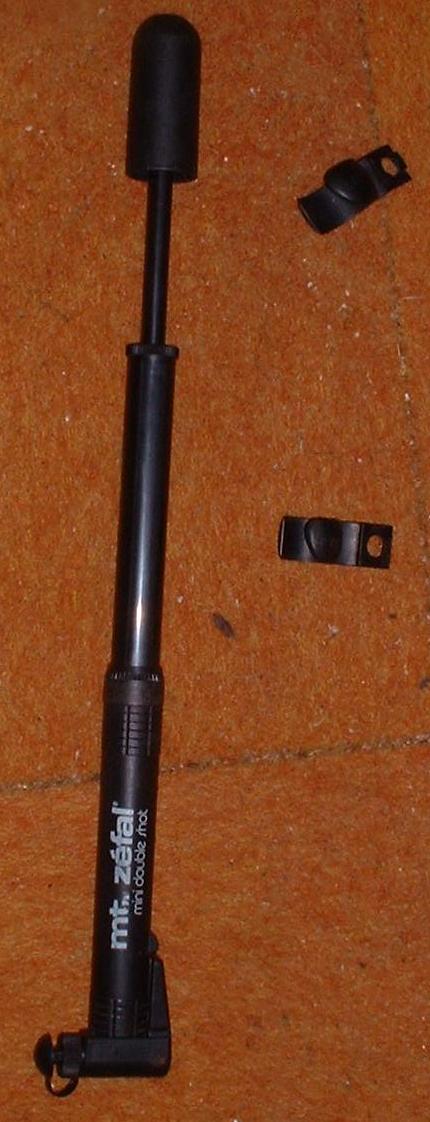
Claimed pressure: ? (I don't have the instructions any more) I include this pump in my test because it's the first mini pump I used (I got it in 1992). I can pump up to ca. 3.15 bar with difficulty, more isn't possible as the pump itself will leak air at higher pressure. I got this pump with a subscription to the Dutch bicycling magazine 'Fiets', in 1992. Nice, I thought, but it turned out to be useless for road bike tyres... The issue in which this pump was offered with a subscription was feb/march 1992 in which there was no mention that this pump wasn't suited for road bike tyres. It did say the pump pumps both when pulling and when pushing, which isn't true. In an earlier issue, nov/dec 1991, the pump was shown and the accompanying text said it was suitable for road bike tyres too. Which it isn't... BSF: Can't say as I haven't got the instructions any more.
Conclusion: Throw this pump away. Or do as I did and give it away to someone who may need it for emergencies on city bikes (such as idiots letting the air of your tyres as their idea of having fun). In this respect it's quite usable, because it's quite light; just stow away with your other stuff in a bag... Rating: 0 |
|
Claimed pressure: ? I pumped to 3.95 bar and had enough. It takes a long time to get one's tyre up to pressure. A 30 to 32mm tyre needs about 200 strokes to get to ca. 2.25 bar. It varies a bit how far you get per stroke: With 50 strokes the pressure in a 32 mm tyre increases by ca. +0.4 to +0.6 bar depending on how far you press the pump handle. This is because there's a spring in it so the pump can be put in the bracket on the rear carrier, but to get maximal travel per stroke you need to press that spring too at the end of the stroke. That takes a lot of effort... Pumping a city bike tyre (ca. 32 mm) to 3.5 bar takes about 350 strokes and at least 5 minutes (with a break to give your arm some rest). BSF: ?
Conclusion: Works pretty well, but it takes a very long time to get a tyre pumped to the desired pressure. Rating: 5 |
|
Tested: From 19 July 2010 This pump is a permanently attached quicker pro, with a hose long enough to get to both front and rear wheel. Claimed pressure: 11 bar. The pressure can be read within the inner cylinder, which you need to do when you pull the pump out, this gives a brief moment at which you can read the pressure, but it works pretty well. With the quicker pro you do have to point the wheel/valve such that you see the bar and not PSI (come on, let go of those archaic 19th century English units), but here you must turn yourself as the pump is fixed. Not nice. BSF: 0.
Negative points are:
Conclusion: Very good pump, interesting concept, but there are definitely a lot of possible design improvements, in particular regarding size, and what I don't particularly like is that mounting it in place of a bottle cage is the only way to prevent the pump to rotate around the frame tube. |
|
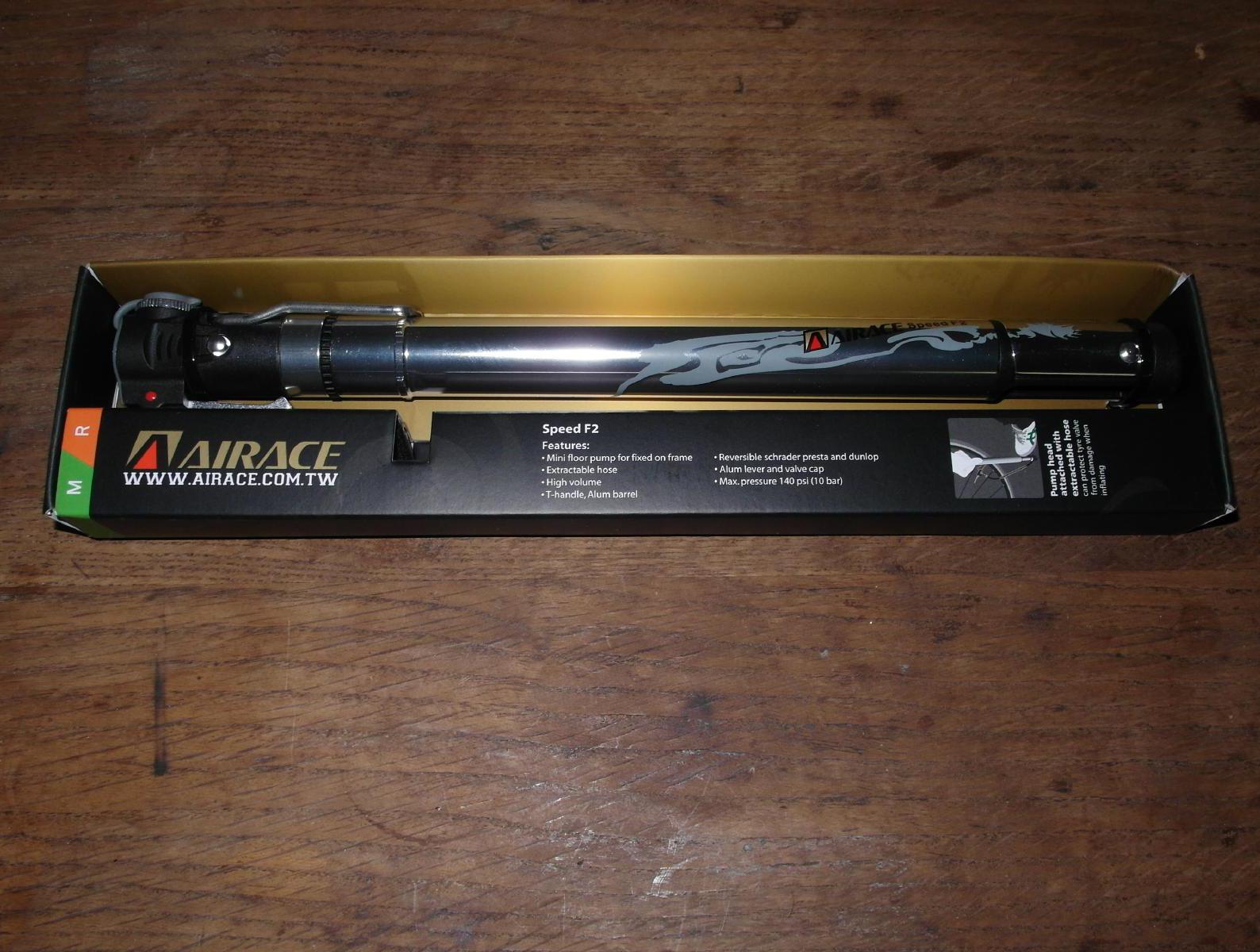
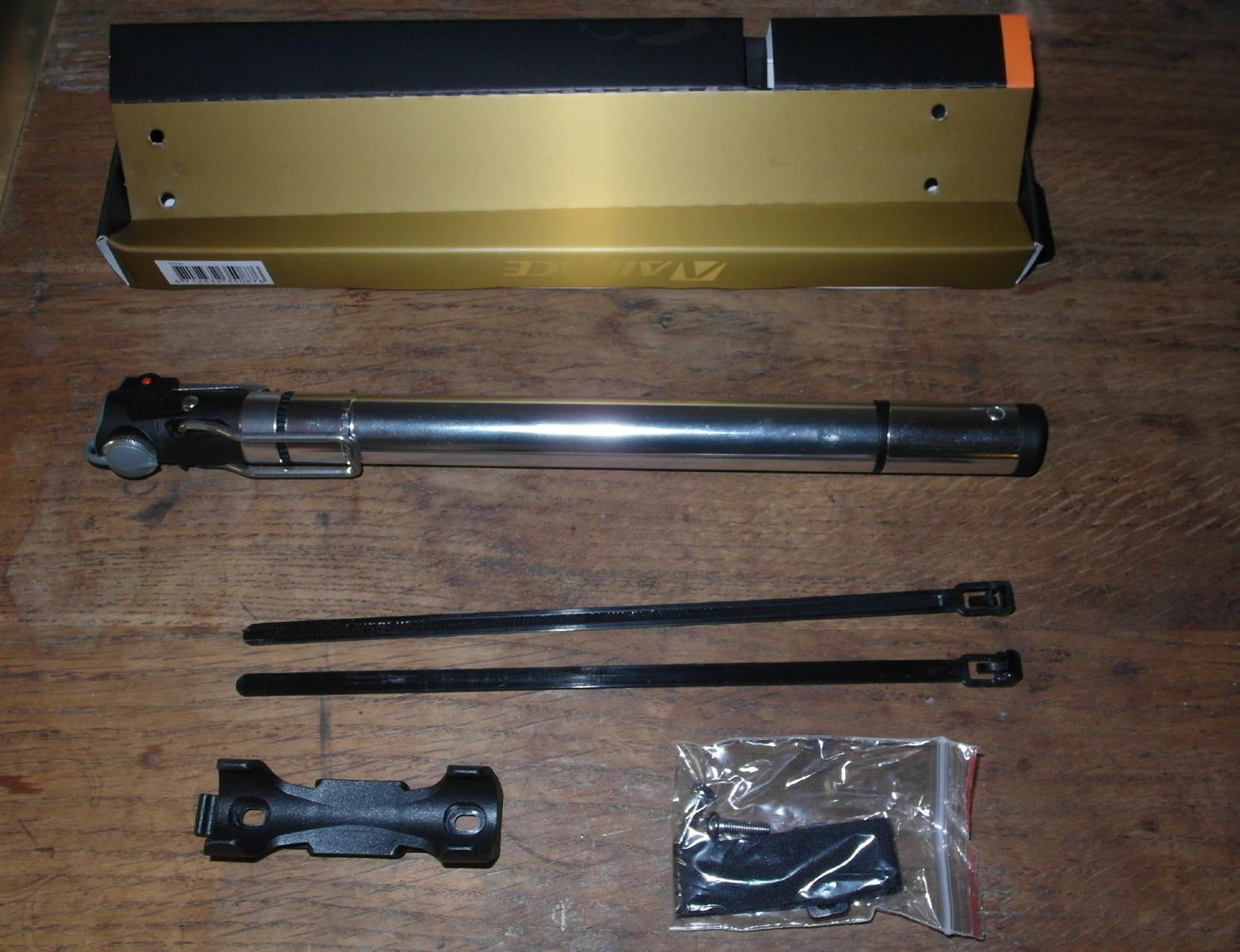
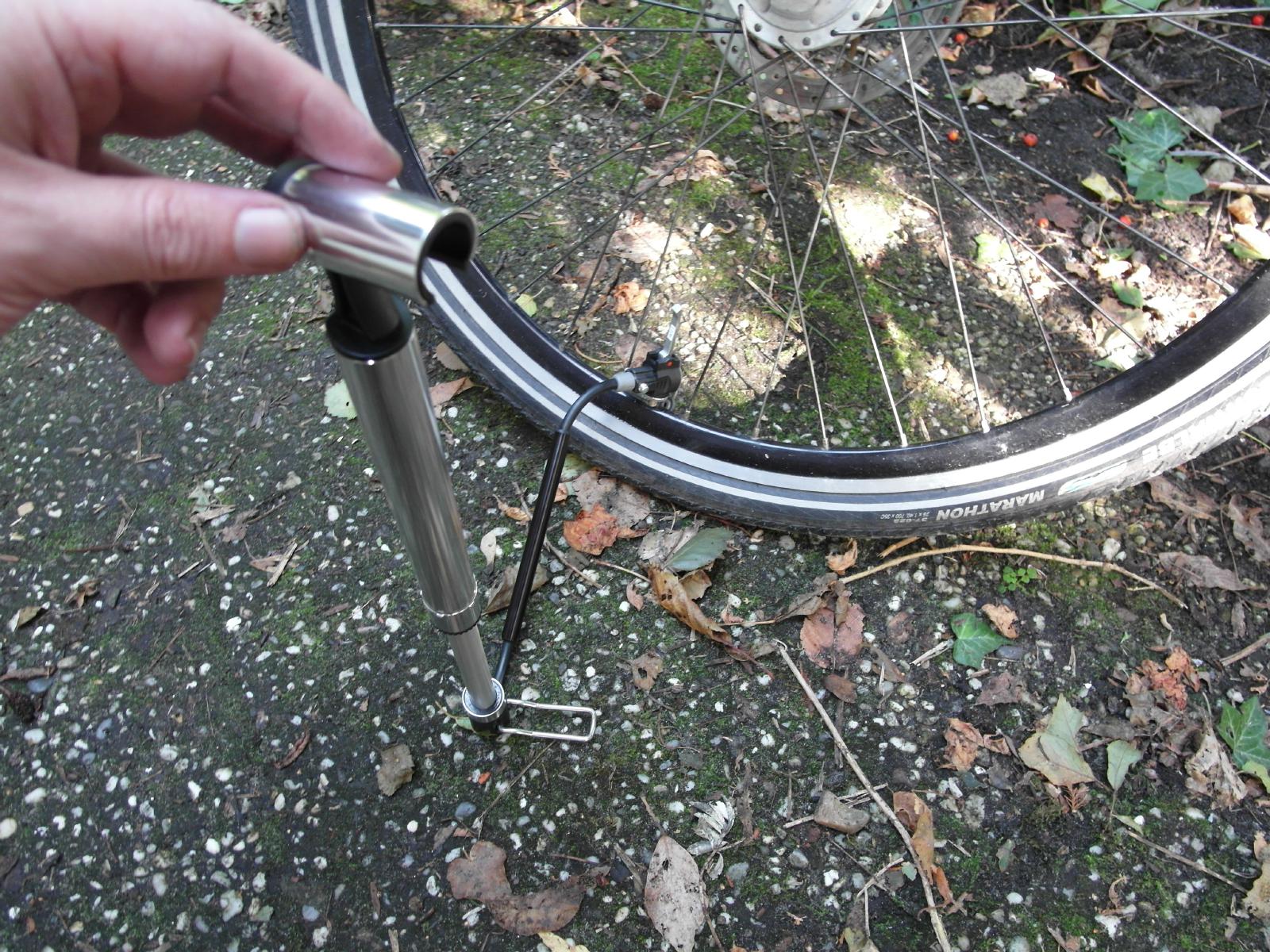
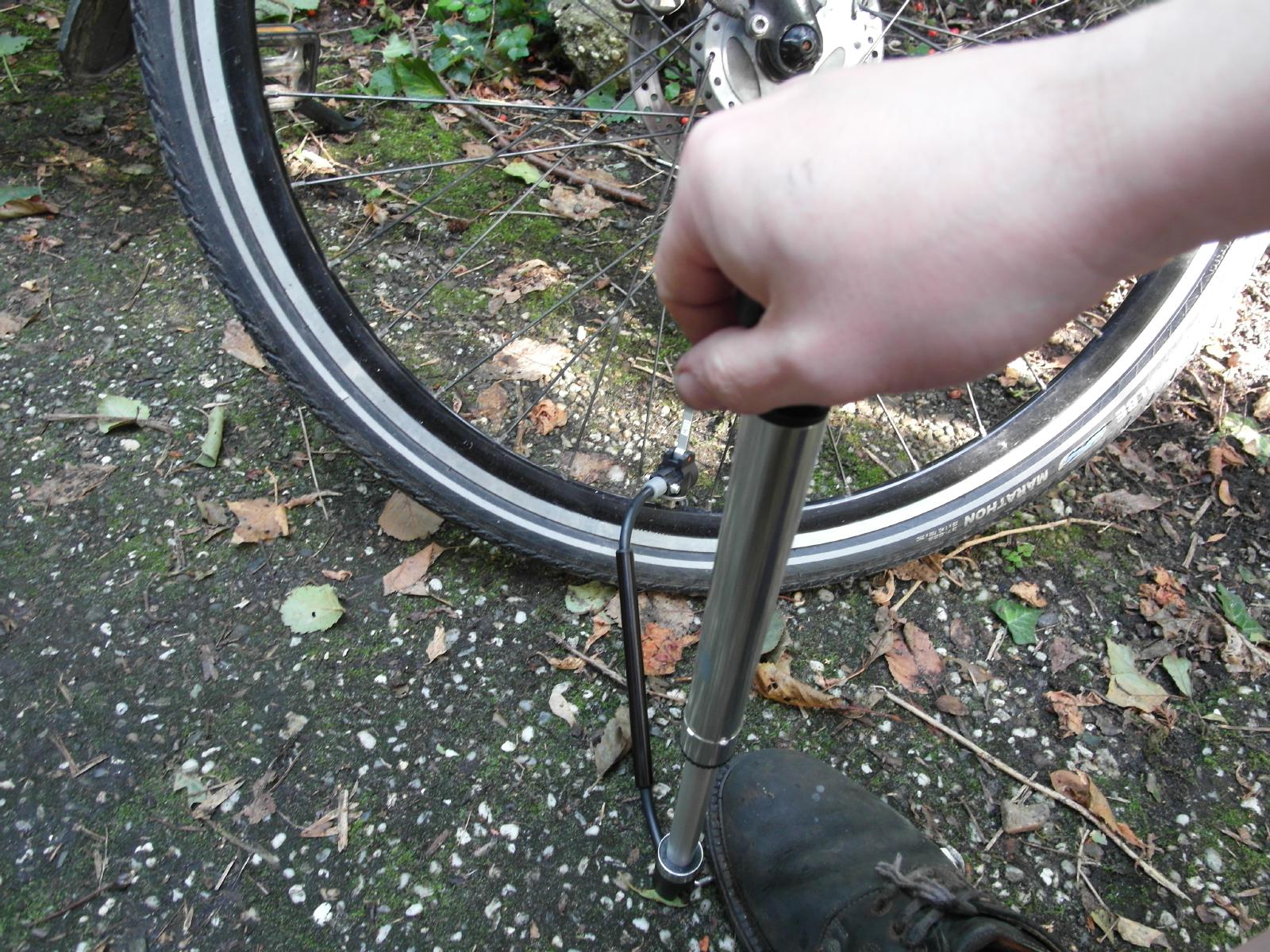
Claimed pressure: 10 bar. Tested: Since 9 August 2011 The pump is beautifully finished, and well thought out in various respects. The fold-out stabiliser, along with some bits sticking out on the main tube, makes sure the pump doesn't extend when it's on the bike. There's a pump handle that rotates out. It is quite long, and very shiny which makes it stand out a lot (not good on bikes you leave unattended, e.g. to do groceries). I'd prefer a black anodized version but that doesn't seem to be available. To the pumping: the pump head with hose extends from the body which is a clever design. Disadvantage of this relatively short hose compared to a full size floor pump is that you need to rotate the wheel such that the valve is near the ground. The pump is fairly long for a small pump, but even more important, it's fairly long for the small stabiliser. This means pumping is an unstable business above esp. 4 bar. The pump handle is nice but too small, in particular the diameter. Because of that, above 4 bar it becomes uncomfortable to pump. But the main problem was trying to keep the pump balanced at higher pressures. It often slipped sideways because of the force and the small stabiliser which doesn't stabilise the pump compared to a full size floor pump. At 6 bar I had enough. It's undoubtedly possible to pump to much higher pressures but it was not nice due to the small diameter pump handle, having to keep to pump from moving away from the balanced position, and it was just hard to pump and I didn't feel much air was going in per stroke.
Airace: Speed F2: Achievable pressure: 6 bar [ You can get to higher pressures, but it is too much work, involves risk to get an injury from the pump shooting away sideways unexpectedly. ] PUpdate 2025-7-12: Problem in 2024: I took the pump on a ride to Amsterdam and found that one of my tyres was a bit soft. I tried pumping it up and the Speed F2 didn't work. When I got home I tried to find the problem and eventually found that it leaked air in the connector that combines the 2 small hose sections that are internal to the pump until you pull it out. It had almost never been used, so this defect must have been present and not a problem until using it a few times. One of the internal seals was damaged. These are fairly intricate and I could not create a simple fix. I shortened the hose by using only 1 section so that I didn't need the seal. This meant I can't put it on the ground and reach the valve any more, but instead I have to use it like any other hand pump. I lowered the rating from 5 to 4. Conclusion: I prefer a Quicker pro... Rating: |
Claimed pressure: 11 bar. Tested: Since 2017-8-10, in progress. I wrote last year in the section on pumps that might be interesting to test:
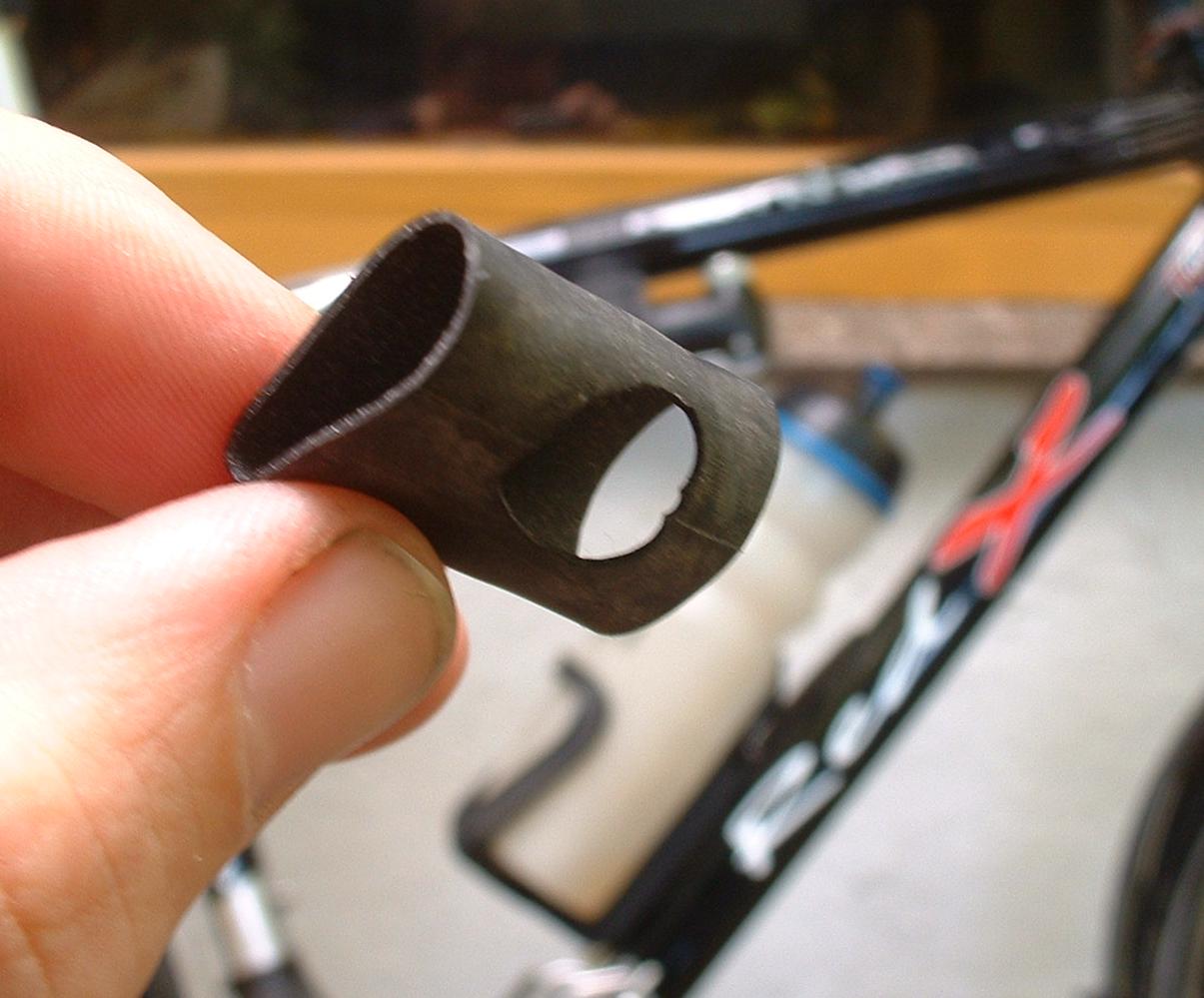
So, now I tested the Birzman velocity apogee RG (road bike pump with gauge, there is also a MG for mountainbike with bigger diameter to more quickly pump bigger tyres), which has a really nice way to attach to Presta valves and screws on Schrader too, perhaps usable on shocks, that Birzman mentions on the carboard that the pump is mounted on, but for 130 PSI (9 bar) as needed for my bike it will get hard to pump, surely. Weight is quite low for having a gauge and hose, namely 118 g, 130g with holder. It has a pull-out hose similar to the Airace Speed F2, which is a much better/quicker solution than the screw on/off type by Lezyne. Pump size is 27.8mm (max, not round) x 223mm, the pump's main tube has a diameter of 18.7 mm outside, ca. 16.7 inside (=piston diameter) so a bit better than the Lezyne Road drive, which means for an average guy a pressure of ca. 6.7 bar can be reached with normal force, and 8.0 bar with maximum force. So not quite into shock pressure range for my bike. If needed it's possible to get to 9 bar/130 psi, but I wouldn't recommend it. The pressure gauge is quite well readable also because it stays at the pumped pressure. Pumping such that the pressure gauge at the centre reads 2 bar, gives a pressure measured with the Airchecker of 2.2 bar, not bad. On both ends there are rubber-like coverings for grip, which works well. What I would like to see different is the colour, it's polished aluminium, I'd like to see it in all black to be 'invisible' on a bike, also for theft prevention. The version without pressure gauge is a bit shorter (which is less good to achieve higher pressures) and is available in black... (at least from the shop that I bought it, perhaps the Velocity apogee RG is available in black elsewhere?) The claimed reachable 11 bar is nonsensical, you risk injury pumping to such pressures. But you don't need such high pressures for even road bikes, 8 bar is enough and really 11 bar is pointless, and thus: BSF = 4: Which means Birzman are quite moderately bullshitting ;) If you really want to pump to 11 bar, you should get a Quicker pro, it's better for your health. For most people (men) the pressure that can be achieved with 'maximal force' is 8.0 bar which is plenty for most purposes, even road bikes, but this is not easy, so for such pressures I recommend a Quicker pro. For women on road bikes, a Quicker pro is definitely the way to go.Strangely for all the quality and well thought out features, the clip to mount the pump has holes that are just 1 mm or so too far apart so I need to do some DIY so it will fit under the bottle cage... Another issue, and this is an important one: The chuck does not stay on the valve on some of my Presta tubes. I'm not sure why. I will check further but apparently it doesn't fix hard enough on the thread at the end of the valve, which may differ a bit per manufacturer. I get the problem definitely with e.g. the Schwalbe SV17. Schwalbe have flattened the thread of valve end on which the cap screws, on 2 sides, which could be part of the problem but another tube that didn't have this but which has no thread on the main body (these seem rare these days) also has this problem. This shows in that with the movement of pumping, the collar that you push down (and screw a little bit), goes up and then the chuck detaches from the valve. For Presta tubes, the chuck only works for Continental tubes that I tried. I have some Michelin tubes that I will try next. So, I tried Michelin tubes and it works with them.
Rating: Unrated due to failures and due to Birzman not responding. |
Claimed pressure: 8 bar. Tested: Since 2023-6-9, in progress. Experiences: I don't particularly like the pressure gauge, it pulls out a bit further if you have the pump pulling on it sideways. The pressure indication could be a lot better. When I pumped a tyre to about 3.2 on the gauge, it was actually ca. 2.8 bar. It was a bit of a mess getting the pump to pump, I need to screw it on the valve more than with the Lezyne pressure drive. The design is similar to Lezyne's separate hose which you screw on one way to pump up tyres with a Schrader valve, the other way for tyres with a presta valve. It looks nice, black and red, but I don't think the pressure gauge is worth it at all, especially not for this price. The machining gives grooves in the head and piston parts, which means grip is pretty good, better than with the Lezyne road drive/pressure drive, and than the Birzman Velocity pump. Update 2025-7-12: Using it in Ukraine I found I had many of the same issues as with other screw-on pump hoses: It tends to unscrew the valves in tubes that have removable cores. I had a lot of issues on my trip in 2024 from Odessa-Nikolayev-Kherson, with flats from goatshead thorns so I tested this pump and the Airace Speed F2 (with shortened hose due to defect in the connector of teh 2 hose sections) quite often! I preferred the Airace Speed F2 and that is nowhere near perfect... Rating: 5/10 |
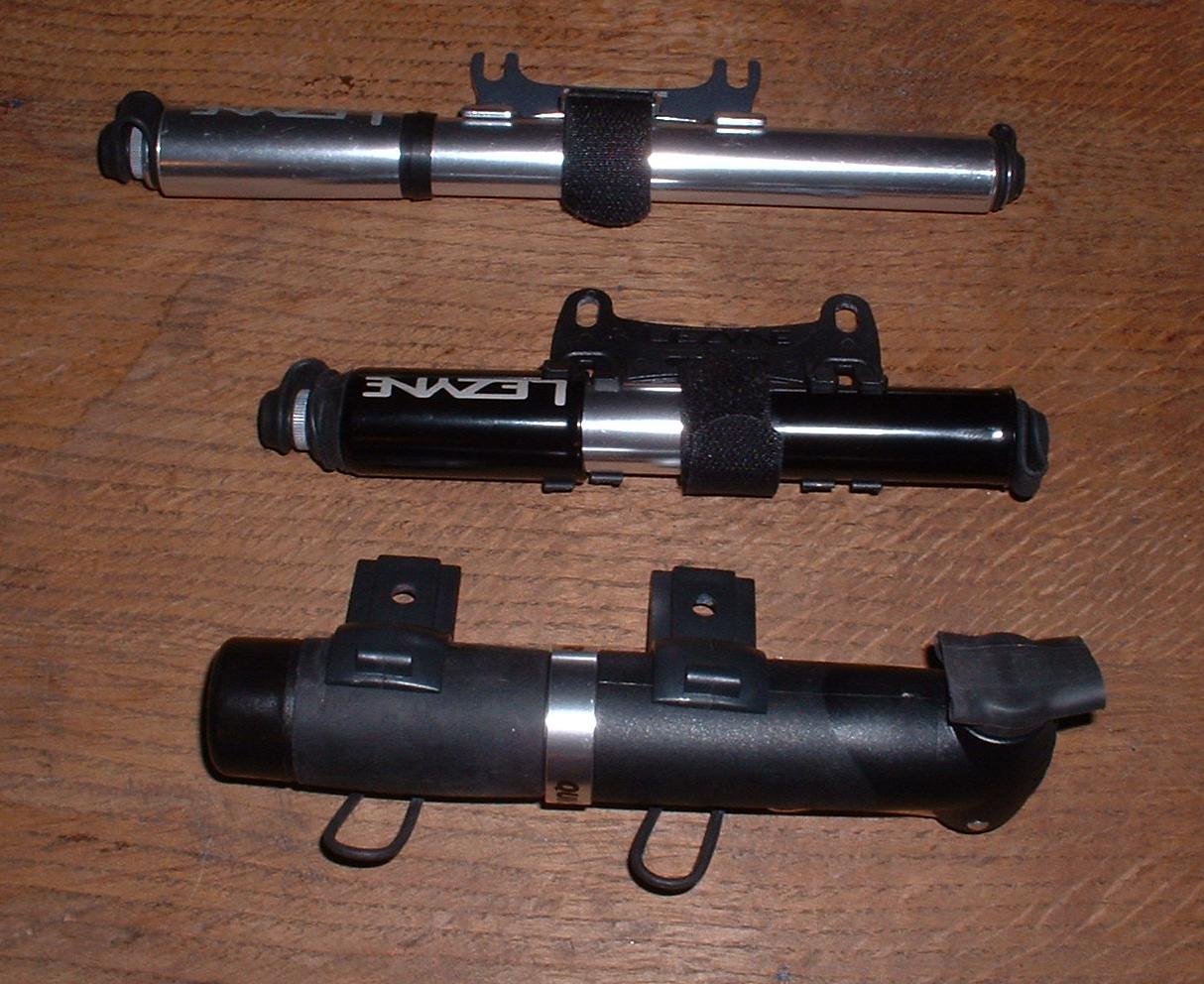
Note: With the pumps I mention if there's a hose, and/or if the pump is not quite a mini pump any more, so more than ca. 20cm long, as this results in being able to exert a higher force without problems as described earlier on this page.
| 3.0 bar | 4.0 bar | 5.0 bar | 6.0 bar | 7.0 bar | 8.0 bar | 9.0 bar | |
|---|---|---|---|---|---|---|---|
| Quickex: Quicker pro | ? 31 N | ? 42 N | ? 52 N | ? 62 N | ? 73 N | ? 83 N | ? 93 N |
| Lezyne: Road drive (hose, longish pump) | 71 N | 95 N | 119 N | 143 N | 166 N | 190 N | 214 N |
| Gazelle | 68 N | 91 N | 113 N | 136 N | |||
| Lezyne: Pressure drive (hose) | 90 N | 119 N | 149 N | 179 N | 209 N | 239 N | |
| Rose Versand: Xtreme Big Volume (long pump) | 141 N | 188 N | 235 N | 282 N | 329 N | ||
| Zefal: Mini double shot | 121 N | - | - | - | - | - | - |
| BBB: BMP-17 | 124 N | 165 N | 206 N | 247 N | 288 N |
To pump up a tyre to 3 bar with the BBB BMP-17 Windgun, you must apply the following force:
F = A * p = Pi * r2 * p
[ where A = surface of the piston, p = pressure ]
so:
F = 3.14159 * (0.0229 m/2)2 * 3.0 E5 Pa = 124 N
[ because 1 bar = 1E5 Pa ]
This equates to lifting a weight of 124/9.81 = 12.6 kg. You must apply that force with both hands! To pump to 6 bar with the same force, the inner diameter of the pump would have to be 22.9 mm * √(3.0/6.0) = 16.2 mm or less. To get to 8 bar with the same force, an inner diameter of ca. 14 mm or less would be required...
Now take the Lezyne Pressure drive. Because of the hose one can better hold both ends of the pump and therefore better apply pressure, one can get more from that with the same piston diameter. For the 6.1 bar that I got with the test, one needs to apply a force equivalent to lifting a weight of 18.6 kg...
The Quicker pro is hard to find (which shows that advertisements with nonsense claims from other manufacturers have effect), see http://www.quickex.com/ for dealer/distributor addresses.
The other pumps are easily obtainable from lots of shops and web shops.
| To email me go to the email page |
Last modified: 18-10-2017